Fuzhou, Xiamen, Quanzhou, Sanming, Nanping, Longyan, Ningde, Putian, Zhangzhou, Wuyishan, Jianou, Dehua, Shaxian, Changting, Yongan, Lianjiang, Pingtan
Did you know Fujian ranks first in China for forest coverage?
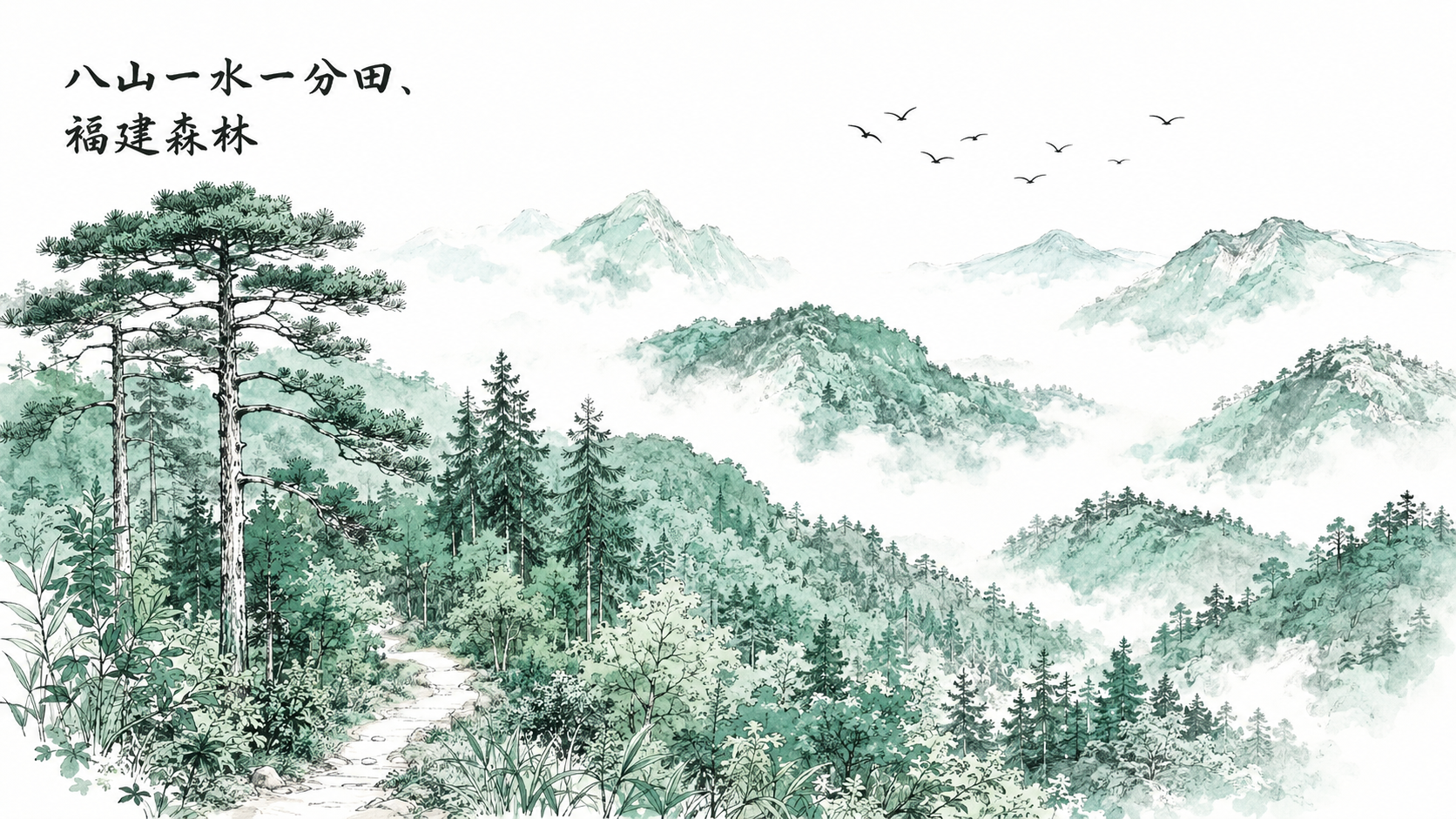
You might think it’s only natural. Fujian is “eight parts mountains, one part water, one part farmland”—lots of hills, lots of trees.
But here’s what you might not know: in 1934, Fujian’s forest coverage was only 18%.
18% is less than Beijing today (about 44%).
From 18% to 60.52%. It took Fujian 66 years.
This is the story of a green turnaround.
From “Deep Forests” to “No Old Trees Left”
Over 2,000 years ago, when Emperor Wu of Han conquered the Minyue Kingdom, his scribes described Fujian as “enveloped in deep forests and thick bamboos, inhabited by vipers and fierce beasts.”
Back then, Fujian was almost entirely covered by primeval forests.
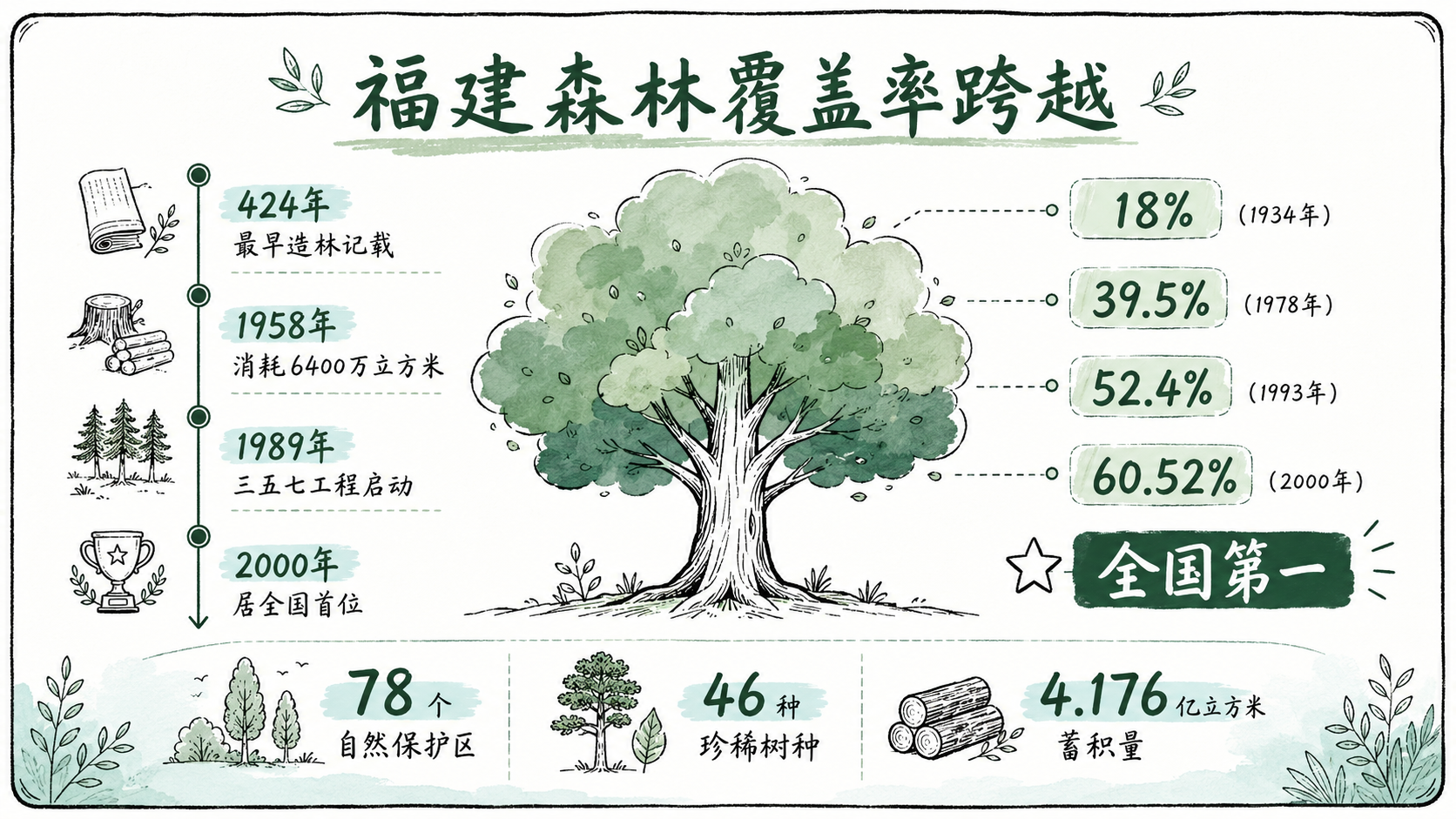
In 424 AD, Hua Jinzhi, the Governor of Jian’an, planted 15,000 pines at the foot of Huanghua Mountain—the first recorded artificial afforestation in Fujian’s history.
In 748 AD, Emperor Xuanzong of Tang ordered a complete ban on woodcutting across Wuyi Mountain. In 1065 AD, Zhang Boyu, the Governor of Fuzhou, ordered every household to plant banyan trees—earning Fuzhou the nickname “Banyan City.”
But modern times brought devastation.
In 1923, Fujian’s timber exports reached 15 million logs, a record high. The cost? “No old trees remained.”
By 1934, forest coverage had fallen to 18%. By 1949, the province’s forest stock was only 120 million cubic meters.
A forest province had been nearly stripped bare.
Thirty Years of Ups and Downs
After 1949, Fujian began large-scale afforestation.
In 1952, the province planted 514,600 mu of new forest and closed 2.48 million mu for natural regeneration. Things were looking up.
Then came the 1958 Great Leap Forward. Steel mills needed fuel, and forests paid the price. Between 1958 and 1961, Fujian consumed 64 million cubic meters of forest resources—19% of its total stock.
In 1960, Fujian mobilized 3 million people to plant trees. It sounded impressive, but the survival rate was extremely low.
By 1964, forest area had recovered to 63.42 million mu. Then it was hit by another wave of logging.
In 1978, coverage had recovered to 39.5%.
Thirty years to go from 18% to 39.5%. Every step was hard-won.
The “3-5-7” Project That Changed Fujian
The real turning point came in 1989.
In May of that year, the Fujian provincial government launched the “3-5-7” afforestation project in Sanming: eliminate barren hills in 3 years, basic greening in 5 years, full provincial greening in 7 years.
Clear goals. Determined execution.
The results?
By 1993, coverage reached 52.4%. Fujian completed its barren hill target a year early and was named “National Advanced Province for Barren Hill Afforestation.”
By 2000, the province’s forest area had grown to 7.35 million hectares, with coverage officially reaching 60.52%. Total standing stock reached 417.6 million cubic meters.
First in the nation.
From 18% to 60.52%. Not by luck—by planting, one tree at a time, generation after generation.
Living Fossils of the Forest
Fujian’s ancient trees are the best witnesses to this green miracle.
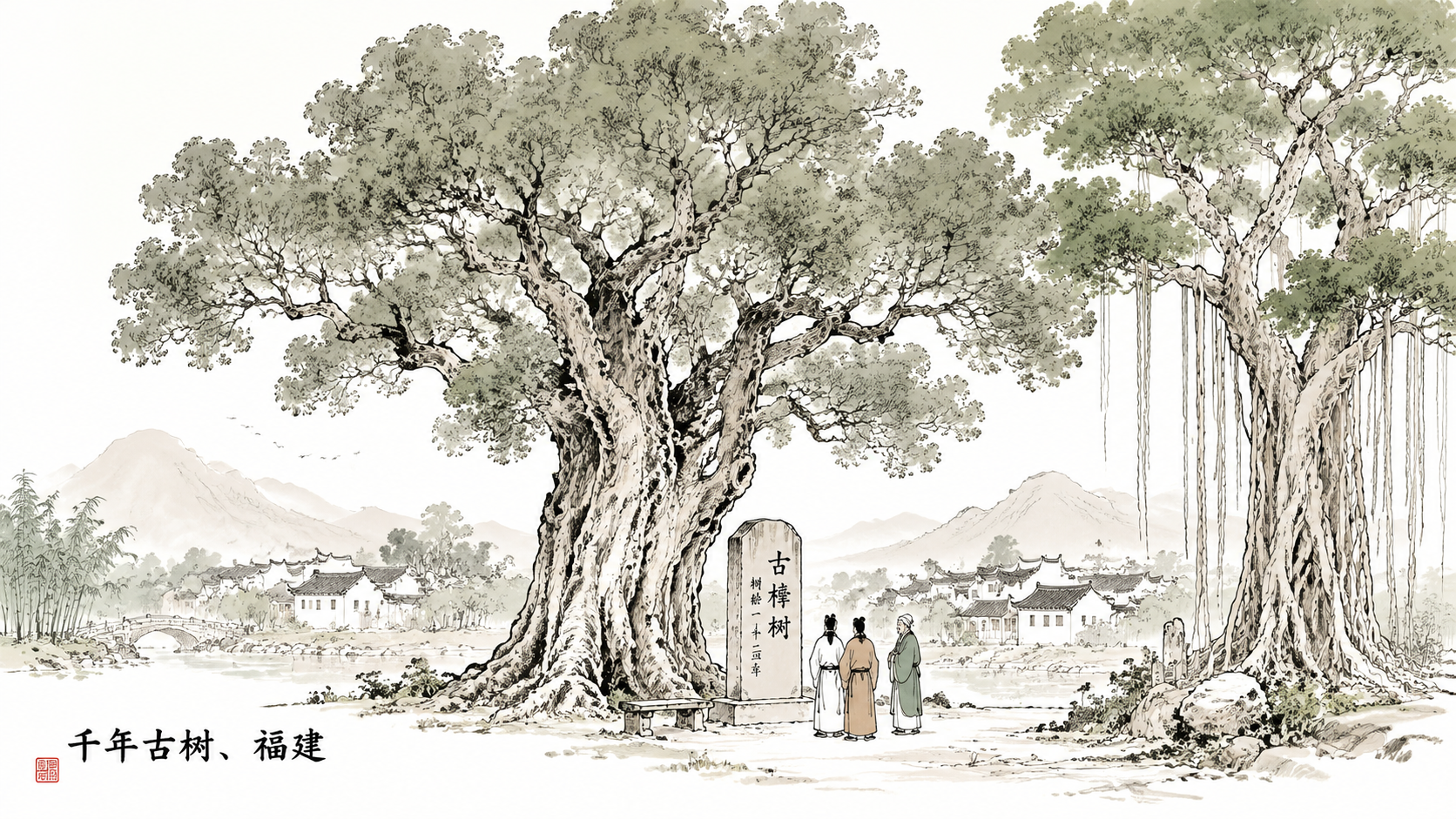
In Ningde, a Chinese fir stands with a diameter of 2.72 meters. It’s over 1,100 years old—the thickest fir in China.
In Dehua, a Tang Dynasty camphor tree towers 26 meters tall with a diameter of 4.5 meters. It’s over 1,300 years old.
In Putian’s Dongshan, a camphor tree planted during the Eastern Jin Dynasty has stood for more than 1,600 years.
On Fuzhou’s Shengfu Road, a banyan tree with a crown of 460 square meters is the living symbol of “Banyan City.”
These trees survived不是因为 luck.
In 1769, a stone stele in Songxi County decreed: “Whether public or private, trees shall be kept to shade the water source; no unauthorized cutting is allowed.”
Centuries ago, the people of Fujian already knew: trees are not to be casually cut down.
The Numbers Behind the Green
Fujian’s forest story can be told in a single timeline:
- 1934: 18% coverage — historic low
- 1978: 39.5% — reform year
- 1989: “3-5-7” project launched
- 1993: 52.4% — target achieved early
- 2000: 60.52% — first in the nation
But that’s not all.
By 2000, Fujian had established 78 nature reserves covering 338,000 hectares. The province hosts 46 rare tree species under national protection, accounting for 13% of China’s total.
A 1988 survey showed that timber forests accounted for 67.6%, bamboo forests 12.2%, and shelterbelts only 4.5% of Fujian’s forested land.
Shelterbelts at just 4.5% — there’s still room for improvement.
But from 18% to 60.52%, Fujian has already achieved something remarkable.
The Trees Know the Answer
From “deep forests” over 2,000 years ago, to 18% in 1934, to 60.52% in 2000.
Fujian’s forest coverage curve is a history of the relationship between its people and nature.
Destroying forests is easy. Growing them back is hard.
But the people of Fujian spent 66 years re-greening mountains that had been nearly stripped bare.
Those 1,100-year-old firs and 1,600-year-old camphor trees are the silent witnesses.
They’ve seen Fujian at its greenest. They’ve seen Fujian at its barest.
And now, they’re seeing it turn green again.
Trees don’t speak. But trees know everything.