Fuzhou, Xiamen, Quanzhou, Jinjiang, Nan’an, Huian, Yongchun, Anxi, Tong’an, Fuqing, Putian, Yongding, Xianyou, Datian, Changting, Shaowu, Mawei, Gulangyu
Have you ever been to school?
To most Chinese today, the question sounds absurd. But a hundred years ago, in Fujian, being able to attend school was a luxury.
The people who changed that were a group of Fujianese living far from home.
One Man’s Obsession
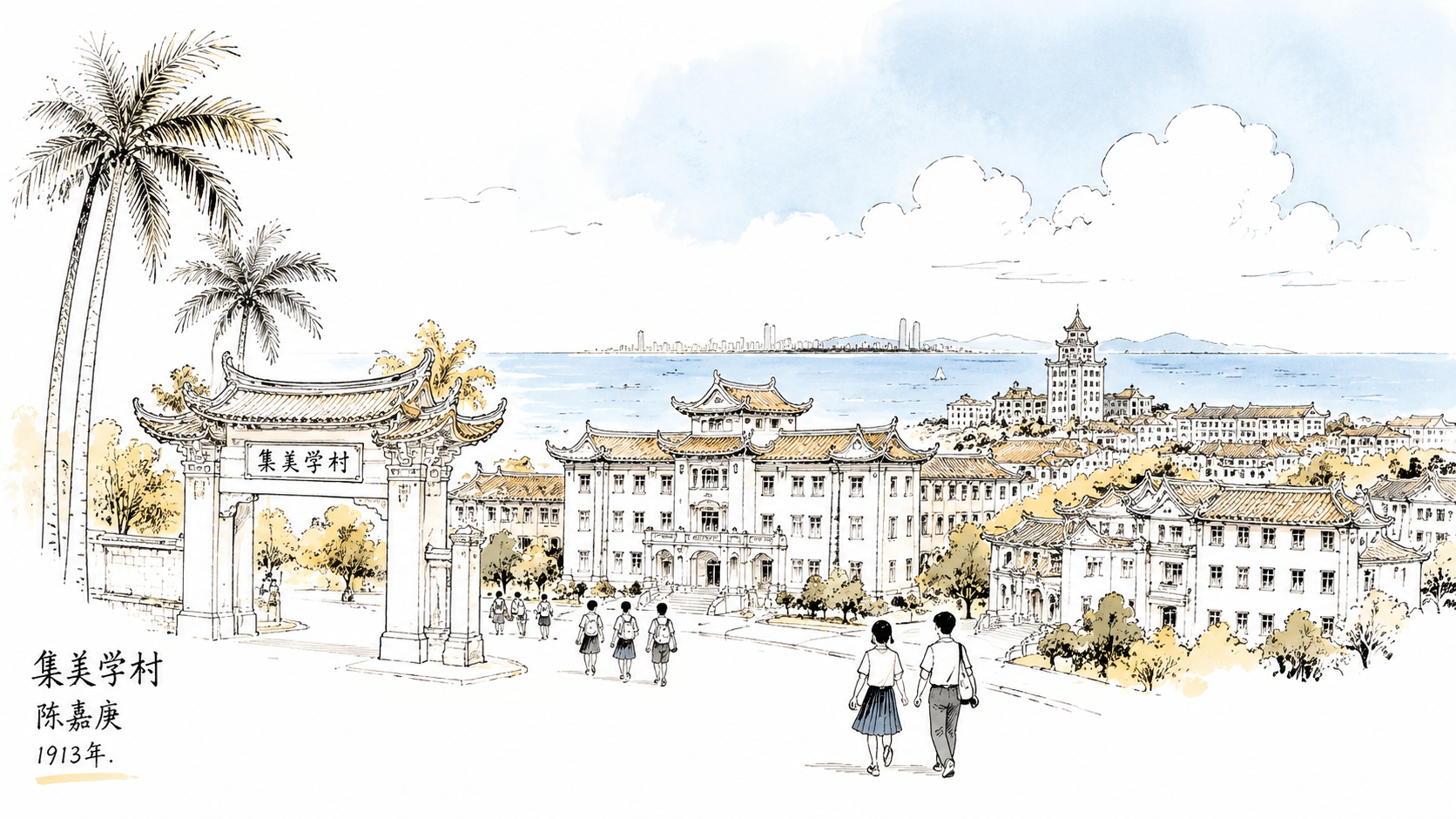
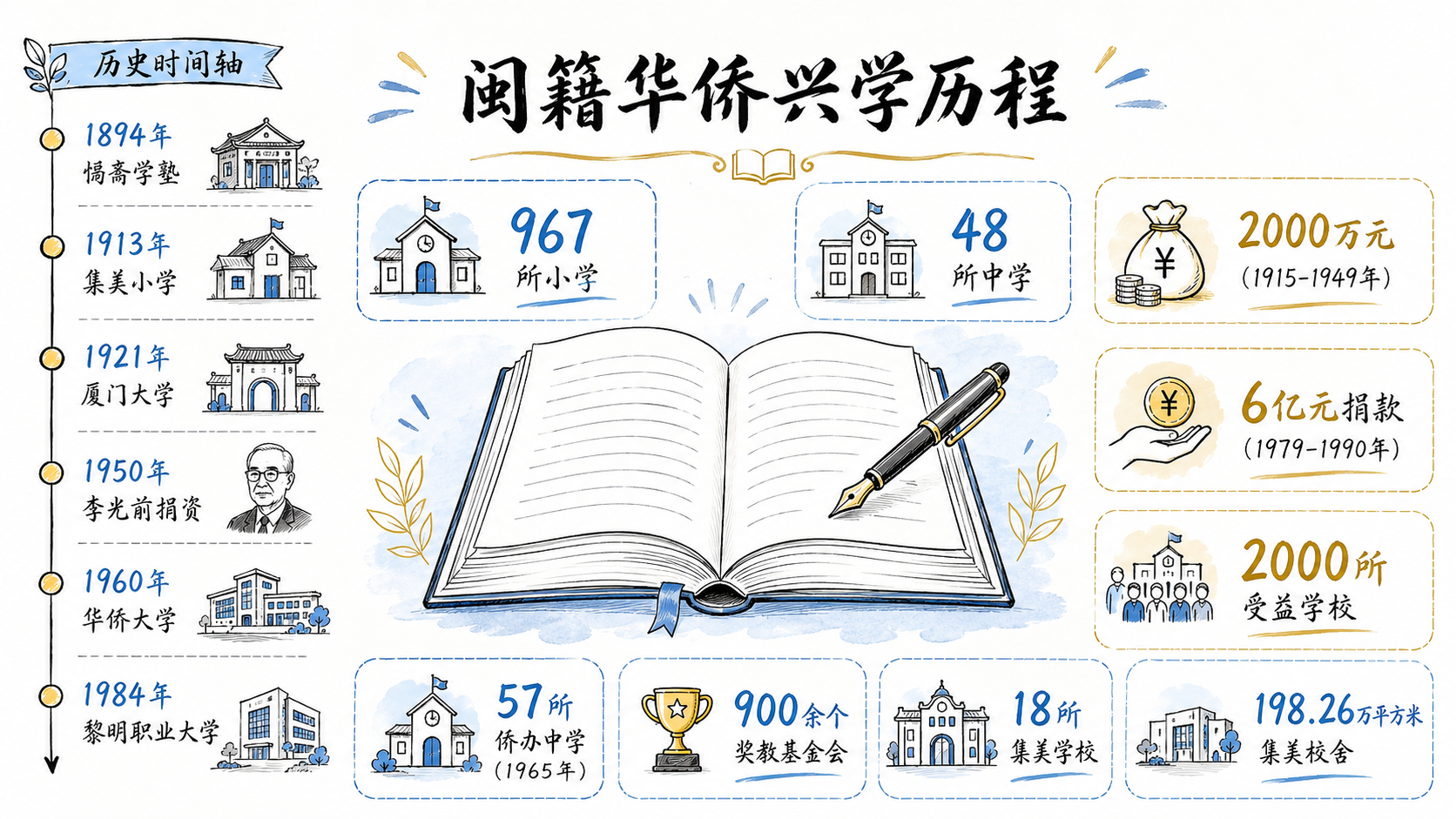
In 1894, the 20th year of Guangxu’s reign. A man named Tan Kah Kee from Tong’an established a small school called the “Tizhai Academy” in Jimei.
He probably didn’t realize at the time—this humble beginning would spark an educational movement lasting more than a century.
In 1913, Tan officially founded Jimei Primary School. In 1918, he opened Jimei Normal School and Middle School. In 1921, he personally donated 4 million RMB to establish Xiamen University—the first comprehensive private university in Fujian.
One man. One university.
It sounds unbelievable today. But back then, it happened.
Tan Kah Kee once said: “I would rather sell my buildings than stop supporting Xiamen University.”
He meant every word.
The Numbers That Stun
Tan Kah Kee wasn’t alone.
Between 1915 and 1949, Fujian’s overseas Chinese funded the construction of 48 middle schools and 967 primary schools, with cumulative donations exceeding 20 million RMB.
48 middle schools. 967 primary schools. 20 million RMB. All in 35 years.
When you look at Fujian’s educational history, one pattern emerges—almost every decent school in modern Fujian had an overseas Chinese backer.
The most remarkable example is Jimei School Village. Starting from 1918, it grew into 18 specialized institutions covering normal education, middle school, fisheries, navigation, commerce, and agriculture.
In 1920, Jimei established the Fisheries Department—one of China’s earliest maritime training programs. In 1926, Tan spent heavily to purchase a 274-ton steel-hulled trawler from France, the Jimei No. 2, giving students hands-on experience.
A fishing village became the cradle of China’s maritime education.
A Letter in 1950
In November 1950, Singapore entrepreneur Lee Kong Chian wrote a letter to Tan Kah Kee.
His message was simple: he wanted to fund the restoration of Xiamen University, damaged by war.
He raised 6 million HKD. Between 1951 and 1954, Xiamen University added 24 new buildings totaling 59,000 square meters—doubling its pre-1949 floor area.
Meanwhile, between 1950 and 1951, Tan Kah Kee, Lee Kong Chian, and Tan Lark Sye jointly raised 8.8 million RMB, matched by government funds, for a massive expansion of Jimei School Village.
In January 1954, the Jimei Overseas Chinese Student Supplementary School opened, enrolling 1,008 students in its first year.
In 1960, the state founded Huaqiao (Overseas Chinese) University in Quanzhou, specifically for returning overseas Chinese students. By 1965, it had 11 departments and 17 majors, with 2,395 students, 95% of whom were overseas Chinese or students from Hong Kong and Macau.
By 1965, Fujian had 57 overseas-funded middle schools with 31,503 students—a six-fold increase over pre-1949 levels.
The Golden Decade
After 1978, overseas Chinese educational philanthropy entered a “Golden Decade.”
In 1983, the provincial government issued regulations encouraging overseas Chinese to invest in education. The floodgates opened.
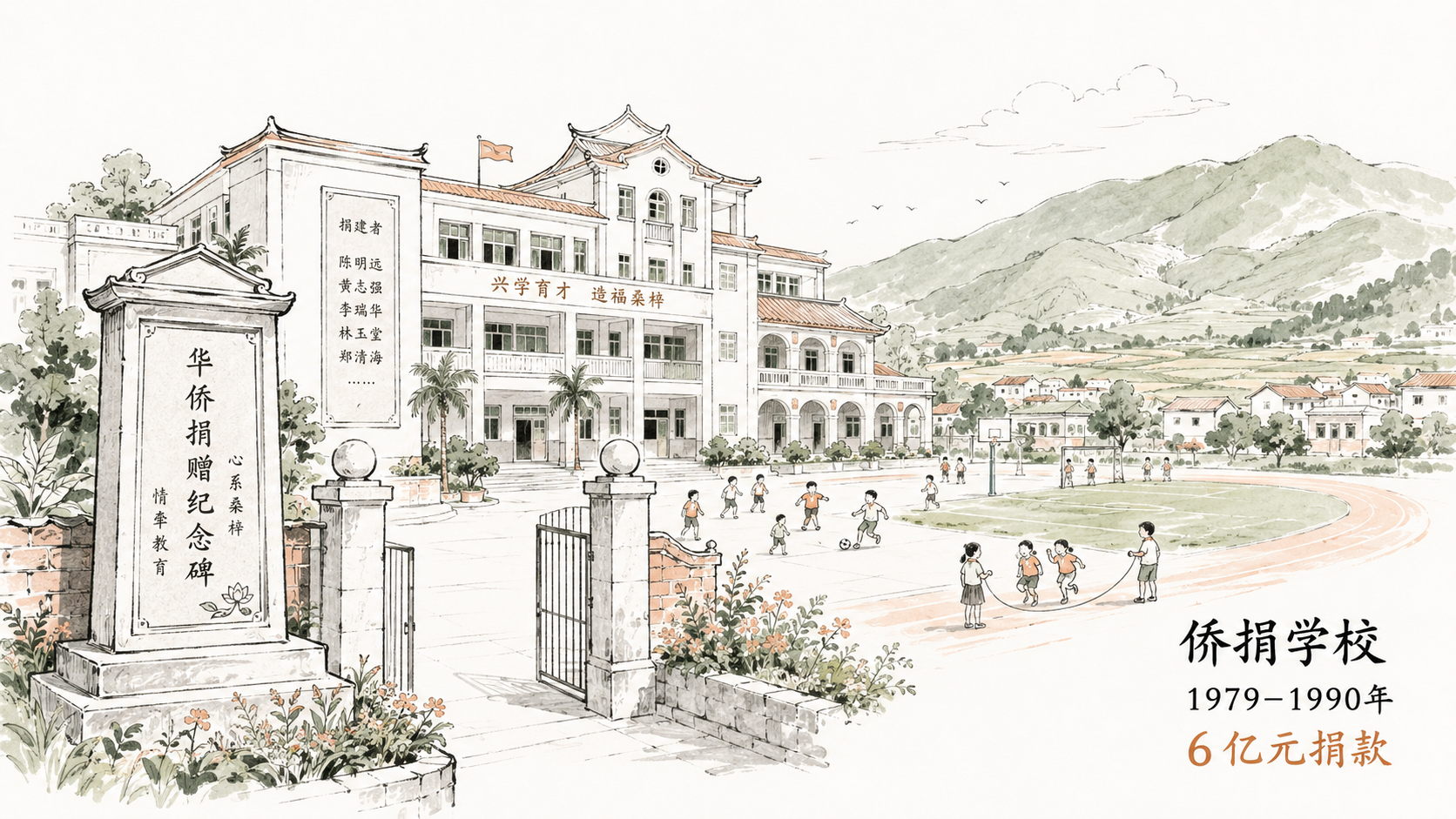
From 1979 to 1990, Fujian received over 600 million RMB in educational donations from overseas Chinese, benefiting more than 2,000 schools.
600 million RMB. 2,000 schools. 12 years.
In 1984, Quanzhou Liming Vocational University was founded. In 1988, Mr. Wu Qingxing donated heavily to establish Yang-En University, with an initial campus of 40,000 square meters.
Perhaps most notably, scholarship and teaching award foundations proliferated across southern Fujian’s Qiaoxiang areas. Over 900 such foundations were established, with total assets exceeding 90 million RMB.
The “Huang Zhongxian Education Foundation,” established in 1989, started with a 20 million HKD donation to support education in Nan’an County.
One overseas Chinese, donating 20 million HKD to his hometown’s education. Not because he had too much money—because he cared.
A Century Measured
From 1827, when returned overseas Chinese Guo Yongxi and his son donated 2,000 taels of silver to build the Wenfeng Academy, to today’s Yang-En University campus spanning 40,000 square meters—nearly 200 years have passed.
The numbers tell the story:
- 1915-1949: 48 middle schools, 967 primary schools, 20 million RMB
- 1950-1965: 57 overseas-funded middle schools, 31,503 students
- 1979-1990: 600 million RMB in donations, 2,000 beneficiary schools
- Over 900 scholarship foundations, 90 million RMB in assets
These figures trace the educational transformation of a single province.
And behind every number stands someone with a shared identity—Fujian overseas Chinese.
The Kah Kee Spirit
By 1990, Jimei School Village hosted 11 major institutions with a total floor area of 1.98 million square meters.
A village school had become a city of learning.
Tan Kah Kee once said: “Take from society, give back to society.”
This philosophy later acquired a name—the “Kah Kee Spirit.”
It’s not a complicated theory. It’s simply a group of Fujianese who worked hard overseas, earned their fortunes, and came home to build schools.
One school. Then another. Then another.
Until every child in Fujian had a place to learn.
Education is the best investment. And these overseas Chinese never asked for anything in return.