Fuzhou, Sanming, Youxi, Jianyang, Shaxian, Longhai, Xianyou, Zhangpu, Lianjiang, Minhou, Nan’an, Tong’an, Sanya (Hainan), Vietnam (Champa)
The rice in your bowl might have come from a seed that changed the fate of a nation.
In 1988, inside the Great Hall of the People in Beijing, a middle-aged scientist from Sanming received the highest honor—the First Class National Science and Technology Progress Award. His name was Xie Hua’an. The variety he held in his hands was called “Shanyou 63.”
Few realized it at the time, but this unassuming rice had already covered 180 million mu across China in just four years. And the number was still climbing.
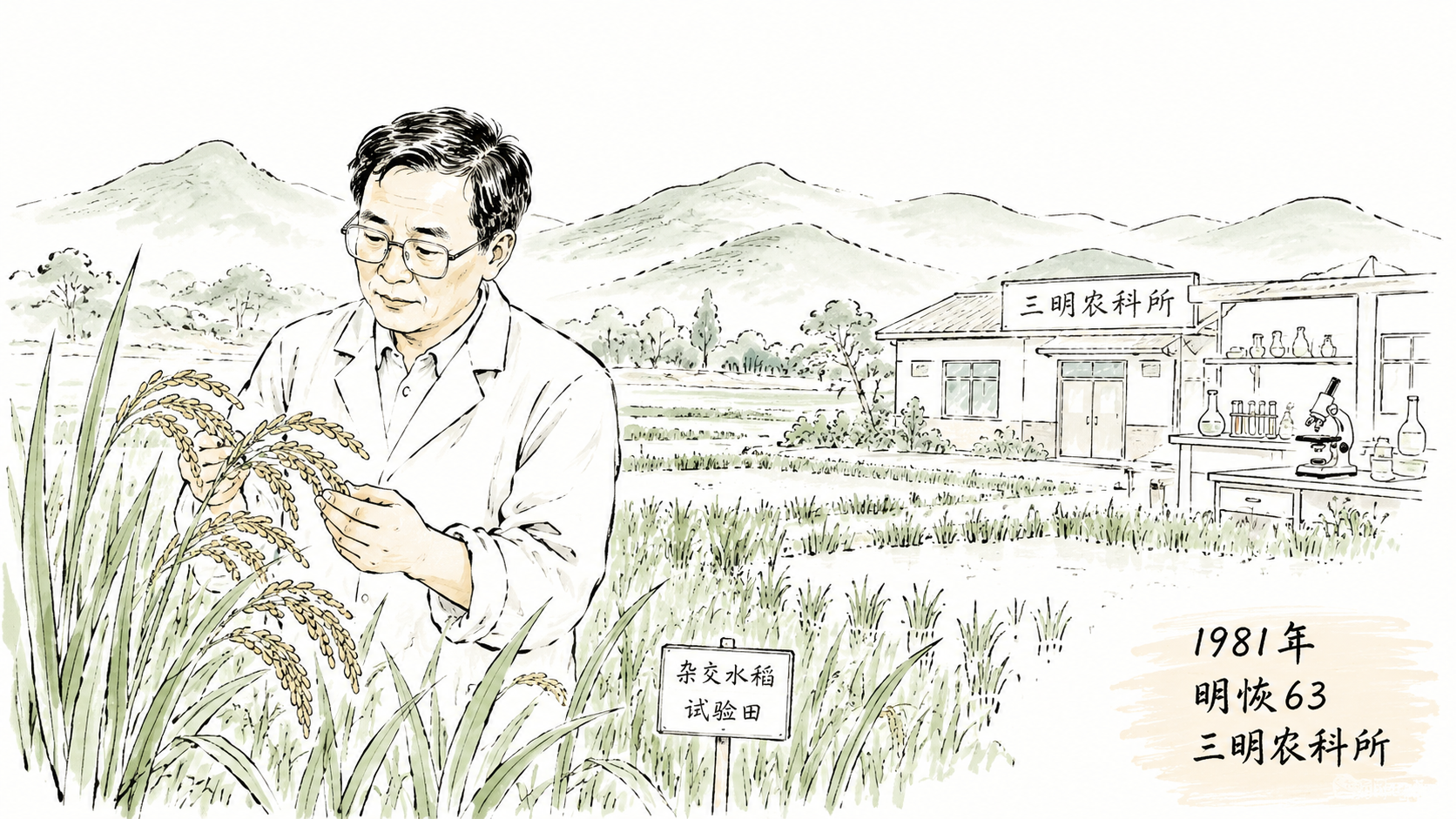
The Birth of a Seed
In July 1971, a specialized research team was formed in Fujian. Their mission: develop China’s own hybrid rice.
What did Fujian look like then? Eight parts mountain, one part water, one part farmland. More than 80% of the province was hills and mountains. Arable land was scarce.
In 1908, the 34th year of Emperor Guangxu’s reign—Fuzhou port alone imported 3.5 million dan (about 210,000 tons) of “foreign rice,” costing 8.5 million silver taels. An agricultural province, reduced to importing rice to feed itself.
In the spring of 1973, Fujian researchers successfully developed the “V41A” sterile line—their first major breakthrough. But the early hybrid “Siyou No. 2,” despite reaching 3.34 million mu by 1979, was rapidly losing its disease resistance. A quiet crisis was brewing.
1981: The Turning Point
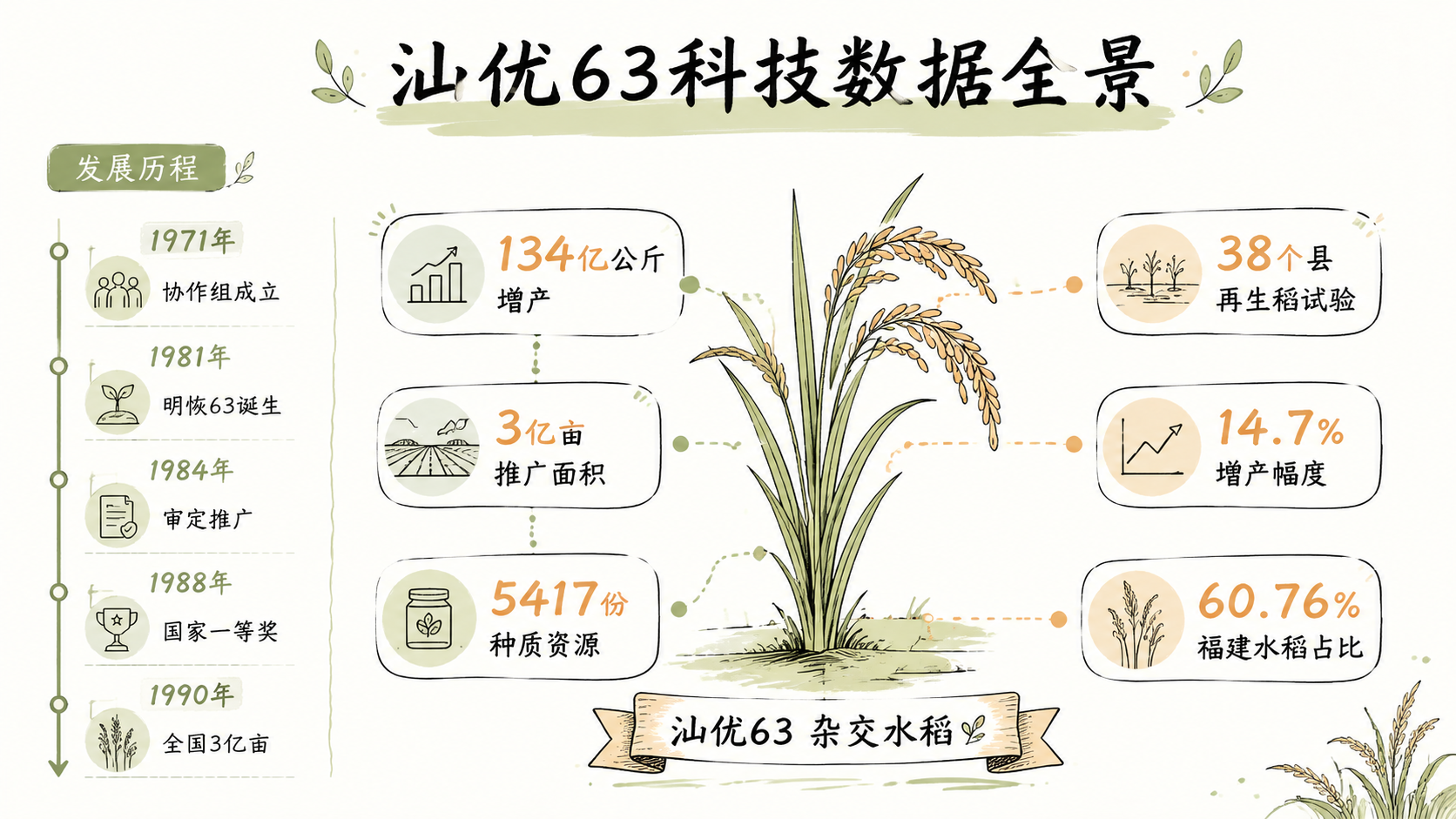
In 1981, at the Sanming Agricultural Research Institute, Xie Hua’an and his team screened through 5,417 rice germplasm resources. From them, they selected the restorer line that would change everything: “Minghui 63.”
The data speaks for itself: in 1982 Fujian trials, “Shanyou 63” yielded 483.05 kg per mu, 14.7% more than the control.
That same year, rice blast swept through northwestern and northeastern Fujian. Conventional varieties fell one by one, their fields turning brown and withered. But “Shanyou 63” stood firm.
The farmers noticed.
1984-1988: 180 million mu cumulatively planted nationwide. 1988: First Class National Science and Technology Progress Award. By 1990: Over 300 million mu, increasing grain production by more than 10 million tons.
In the history of global crop breeding, no variety had ever spread this fast.
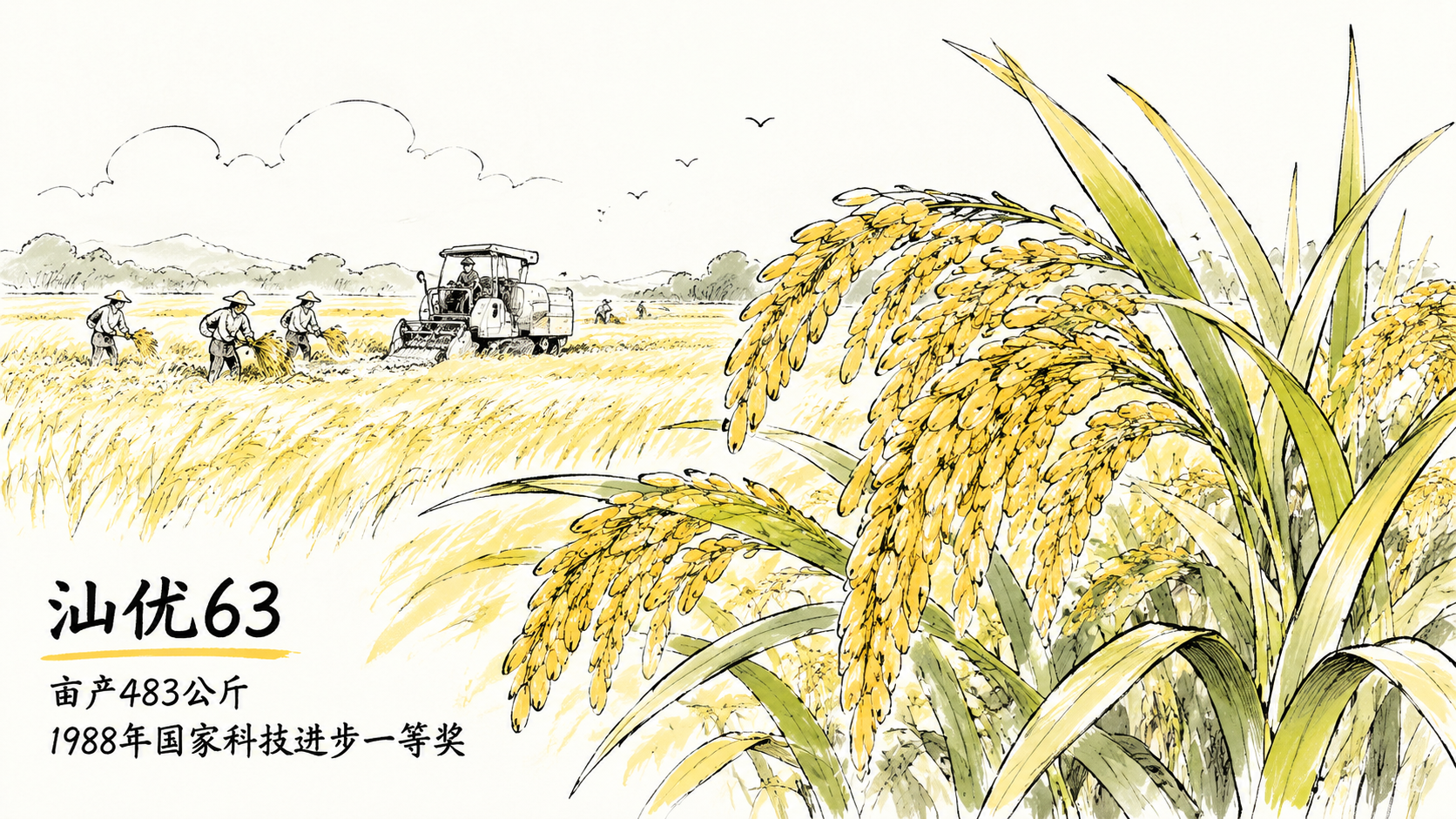
The Secret Weapon: Blast Resistance
Why was “Shanyou 63” so powerful?
The answer: blast resistance.
Rice blast is the “cancer” of rice. An outbreak can reduce yields by 20-30%, or wipe out an entire field. The 1981-1982 epidemic proved this—every susceptible variety collapsed.
But “Shanyou 63” was different. Its resistance came from the “Minghui 63” lineage. The team’s painstaking screening of 5,417 germplasm resources gave it broad-spectrum horizontal resistance. In plain terms: most pathogen races couldn’t touch it.
Behind it all was a rigorous seed management system. By 1987, Fujian had built 127,600 mu of dedicated seed production bases. In Guanqian Township, Youxi County, farm technicians achieved a record seed yield of 359.5 kg per mu in 1988.
Every grain of “Shanyou 63” was carefully selected. That’s why it could be scaled across the nation without losing its edge.
Regenerative Rice: One Season, Two Harvests
“Shanyou 63” had another trick up its sleeve—strong regenerative capacity.
In 1988, the Fujian Agriculture Department organized regenerative rice trials across 38 counties. The concept: after the first harvest, new shoots grow from the stubble for a second crop.
Dongbian Village, Youxi County, achieved an astonishing second-crop yield of 432.9 kg per mu in 1990. One planting, two harvests—effectively doubling output without adding farmland.
In 1989, Fujian officially included regenerative rice in its “Grain Engineering” project, unlocking the potential of 2 million mu of single-crop paddy fields.
The big picture: Fujian’s total grain output rose from 2.83 million tons in 1949 to 9.223 million tons in 1990—an average annual increase of approximately 2.94%. The contribution rate of science and technology reached 35.7%. By 1990, Fujian had 316 major scientific awards at or above the provincial level—and “Shanyou 63” was the brightest star.
A Legacy That Traveled the World
Fujian’s story didn’t stop at China’s borders.
Since the 1960s, Fujian has sent over 530 experts to 13 countries, including Mali and Guyana. In 1980, China licensed its hybrid rice patent to a U.S. oil company—the first such technology export—and the variety was “Siyou No. 6,” developed with Fujian’s participation.
From being fed by “foreign rice” to exporting technology to the world. That journey took Fujian more than 70 years.
Xie Hua’an’s story is recorded on the first page of the Fujian Provincial Annals: Agricultural Records. But here’s what I want to say:
Behind every grain of rice, there are silent people spending their lives fighting hunger.
They don’t produce food. They are merely the ferrymen of rice.