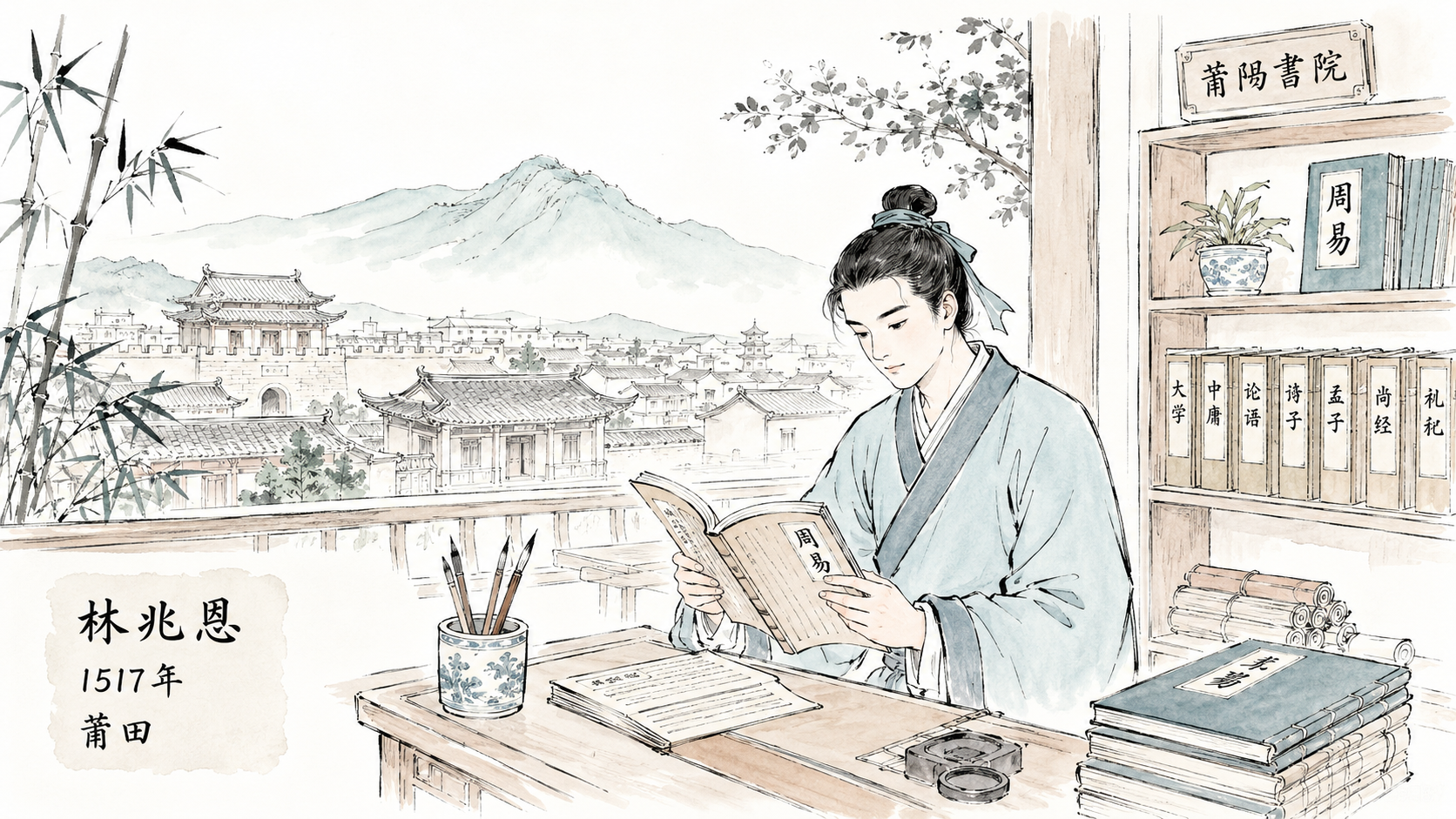
In 1517, Lin Zhao’en was born into an elite family in Putian.
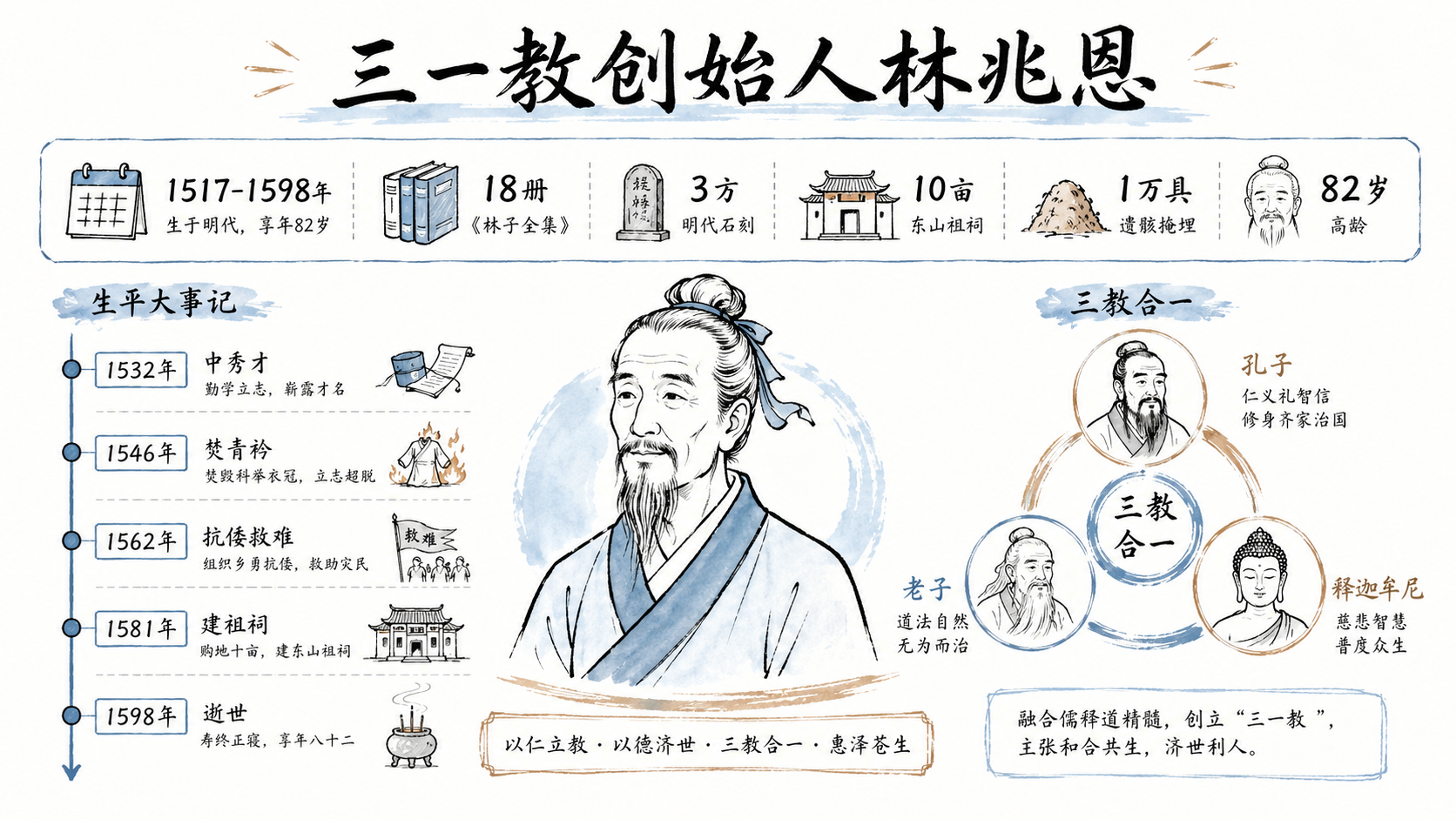
His grandfather, Lin Fu (1474-1544), earned his Jinshi degree in 1502 and rose to become the Vice Minister of War and Viceroy of Guangdong and Guangxi. Lin was a child prodigy, passing the local civil service exam to become a Xiucai at age 15 in 1532.
However, a pivotal shift occurred in 1546. At age 30, frustrated by his failure in higher-level imperial examinations and disillusioned by the rigid Neo-Confucianism of the time, he burned his scholar’s robes and abandoned the traditional career path. He turned his focus to Buddhist metaphysics and Taoist longevity practices, seeking truth outside the Confucian canon.
Putian City, Dongshan, Chizhu Mountain, Ningde, Fu’an, Wenzhou, Nanshan
Elite Lineage and Intellectual Rebellion
Lin Zhao’en (1517–1598), courtesy name Maoxiao and art name Longjiang, was born in 1517 (Zhengde 12) into a family of immense political influence.
His grandfather, Lin Fu (1474-1544), earned his Jinshi degree in 1502 (Hongzhi 15) and rose to become the Vice Minister of War and Viceroy of Guangdong and Guangxi. Lin was a child prodigy, passing the local civil service exam to become a Xiucai at age 15 in 1532 (Jiajing 11).
However, a pivotal shift occurred in 1546 (Jiajing 25). At age 30, frustrated by his failure in higher-level imperial examinations and disillusioned by the rigid Neo-Confucianism of the time, he burned his scholar’s robes and abandoned the traditional career path.
Around 1551 (Jiajing 30), Lin Zhao’en retreated to Chizhu Mountain for solitary study. Records indicate that during this period, he deeply analyzed the I Ching and was heavily influenced by Zen Buddhism. This was not a mere whim but a response to social chaos. He believed that the moral decay and social crises of the mid-to-late Ming Dynasty could only be resolved by integrating Confucian ethics, Taoist life-cultivation, and Buddhist mindfulness.
Pirate Catastrophe and Heroic Deeds
Lin was not just a thinker but a man of action.
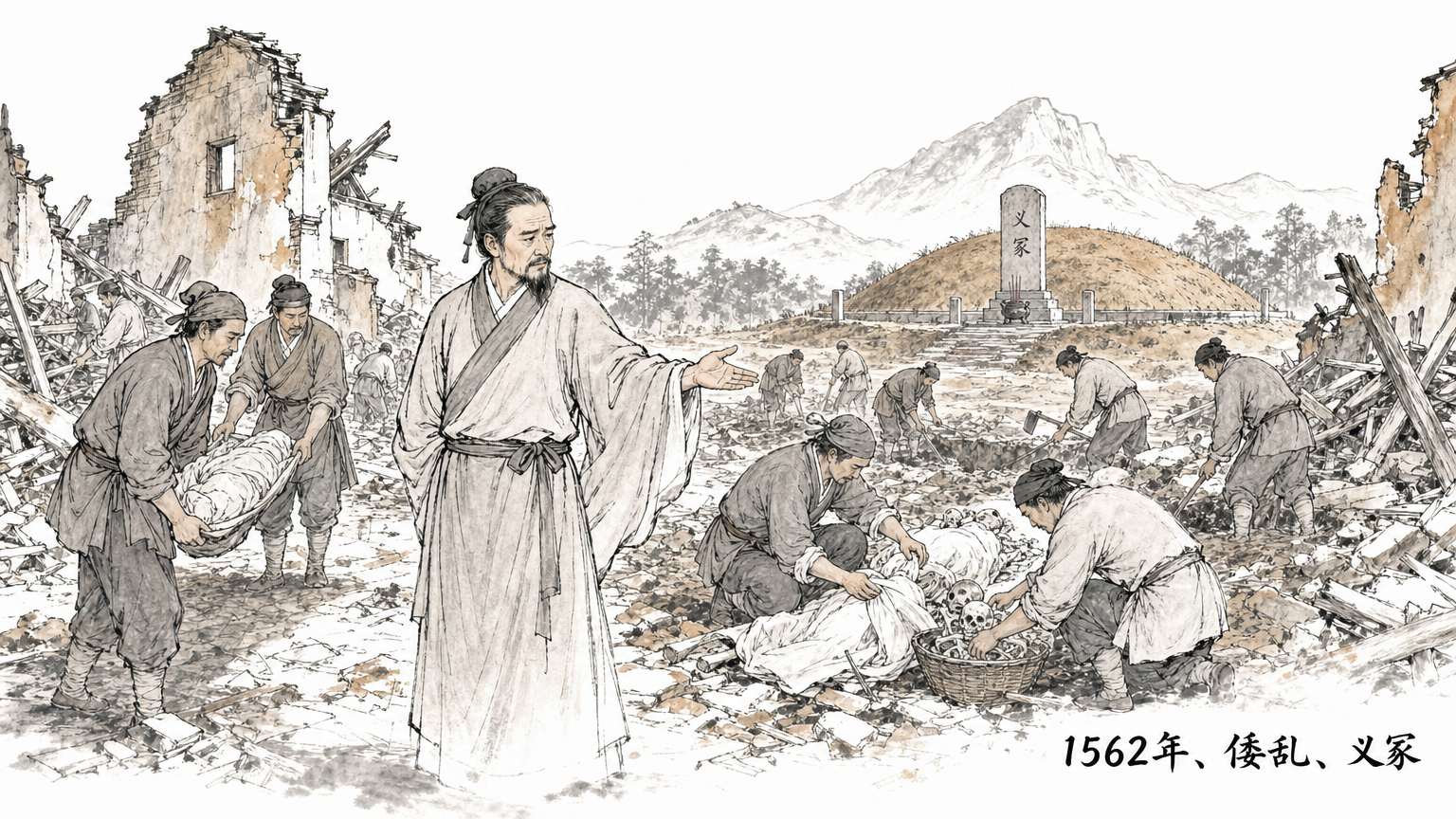
In the 11th month of 1562 (Jiajing 41), Putian suffered its most devastating Wo-kou (pirate) invasion. The prefectural city of Xinghua was captured and occupied for over 60 days. This was the only instance in the Ming Dynasty where a prefectural capital fell to pirates. According to the Biographies of Putian, tens of thousands were killed, and the city was plagued by pestilence.
In early 1563 (Jiajing 42), Lin Zhao’en entered the ruined city regardless of his safety. He used nearly all his family’s wealth to hire labor for the collection and burial of the deceased.
Data Point 1: He constructed massive “public graves” in the Nanshan area, burying more than 2,000 sets of remains in a single site. Data Point 2: Throughout the resistance period, he personally managed or organized the burial of over 10,000 bodies.
This altruism, which transcended clan lines, shocked society and earned his “Three-in-One Teaching” immense grassroots prestige. He provided not just physical burial but also syncretic rituals to soothe the psychological trauma of the survivors.
Three-in-One Doctrine and Spiritual Kingdom
Lin systematically proposed the “Three-in-One” (San-Yi-Jiao) ideology, arguing that “Tao is based on Confucianism, reaches its peak in Buddhism, and uses Taoist immortality as a ladder”.
He perfected this system during the Wanli era. He unified Confucius’s “Benevolence,” Laozi’s “Nothingness,” and Buddha’s “Emptiness” into the “Nine-Step Heart Method”. This doctrine was called “Xia Jiao” (Summer Teaching) at the time, as he saw himself as an inheritor of Chinese orthodoxy.
Lin’s missionary approach was remarkably modern. Utilizing his family’s prestige and his social capital from the pirate wars, he established a tight organization across Fujian, Zhejiang, and the Yangtze-Huai regions.
Scale Data: By his late years, around 1592 (Wanli 20), hundreds of “Three-in-One” ancestral halls and branches had been established in Putian alone. Audience Diversity: His followers crossed all social strata, from high-ranking generals like Qi Jiguang (who consulted him on health) to lower-class farmers and artisans.
Material Legacy and Literary Heritage
Lin’s most famous physical legacy is the Dongshan Ancestral Hall in eastern Putian.
In 1581 (Wanli 9), he expanded his teaching facilities at Dongshan, creating a complex for worship, lectures, and self-cultivation.
Extant Artifacts: Dongshan currently preserves 3 Ming Dynasty stone inscriptions detailing Lin’s late-life lectures and the sect’s regulations. Spatial Layout: The complex covered nearly 10 acres (approx. 10 mu), and its structure mirrored a hybrid of a Confucian academy and a Buddhist monastery.
Lin was an incredibly prolific author. After his death in 1598 (Wanli 26), his disciples compiled his life’s work into the Linzi Quanji (Complete Works of Master Lin).
Literary Density: The collection consists of 18 volumes, including essays, letters, scriptural commentaries, and poetry, totaling hundreds of thousands of characters. Historical Impact: This work was reprinted in 1611 (Wanli 39) and circulated widely among the people, eventually reaching overseas communities.
Historical Evaluation and Eternal Commemoration
Under the Ming’s strict religious controls, the Three-in-One Teaching survived because of its deep-rooted Confucian emphasis on loyalty and filial piety.
In the early Wanli years, Lin wrote several letters to high officials, stressing that his teachings aimed to “rectify hearts and improve customs”.
Lin Zhao’en passed away in 1598 (Wanli 26) at the age of 82. To commemorate his merit in collecting remains and eradicating disease during the Jiajing pirate raids, a unique local custom of “Double Ninth Worship” formed in Putian. Every year on the 9th day of the 9th lunar month, the people not only climb mountains but also visit Three-in-One shrines to honor the “Master Lin.”
Lin Zhao’en’s life was a journey from personal self-actualization to social salvation. With the backbone of a Confucian, the compassion of a Buddhist, and the detachment of a Taoist, he constructed a spiritual home for the masses amidst the chaos of the late Ming Dynasty.
From Confucian elite to spiritual master, Lin Zhao’en embodied true responsibility through action.