Putian City, Xinghua Plain, Mulan Creek, Huangshi Town, Lingyun Temple, Xishi Shanshe, Eighteen Battle Paths, Seventy-two Peaks
Have you ever heard of a mountain that can predict the weather?
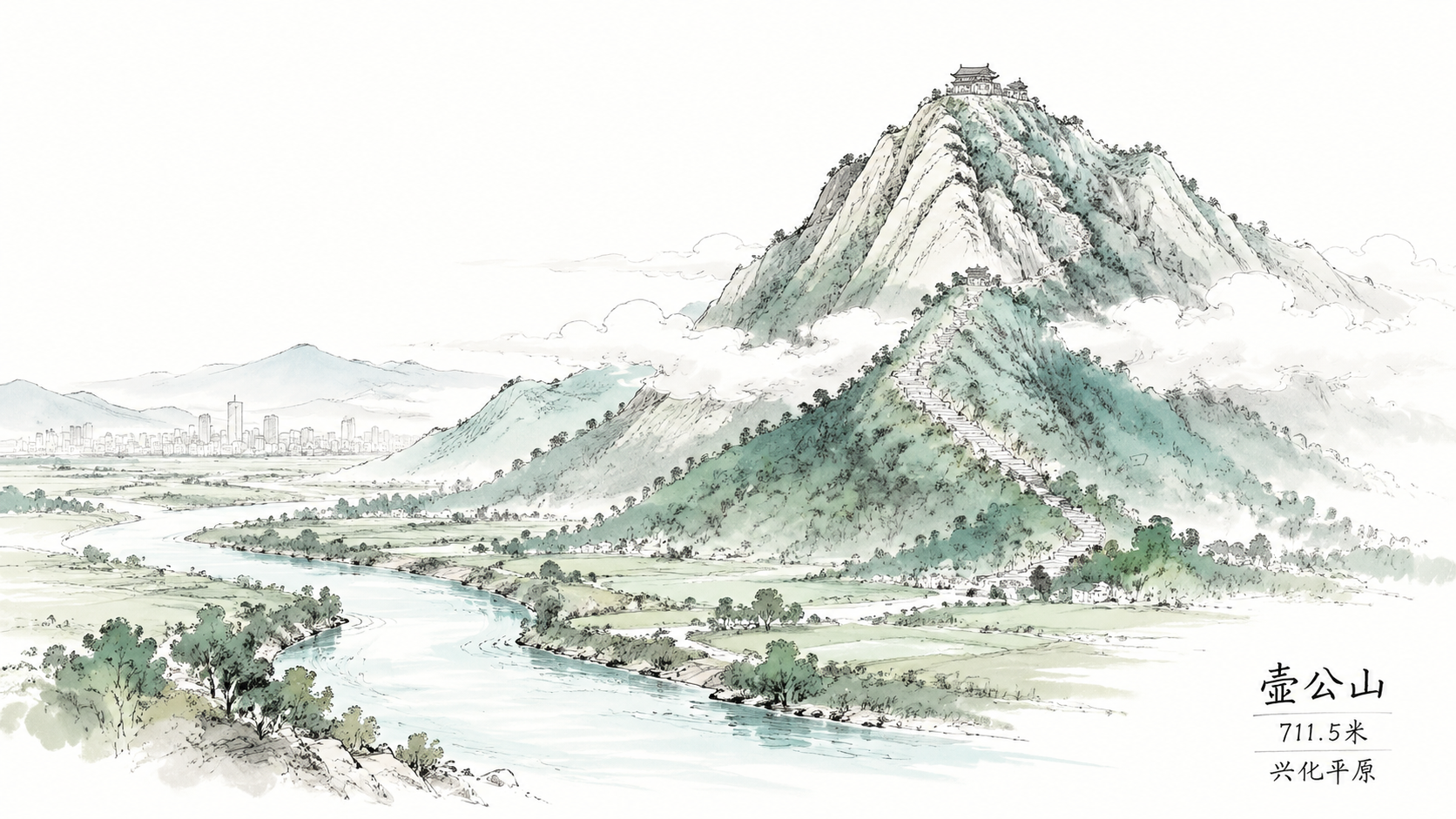
The people of Putian call it Mount Hugong. At 711.5 meters, it’s not particularly tall. But in the hearts of Putian locals, this mountain carries more weight than any famous peak.
Why? Because it “speaks.”
When mist locks its mountainside, rain will fall within 24 hours. The county gazetteer from the Qianlong era of the Qing Dynasty recorded a local proverb: “When Mount Hugong wears a hat, the laborers go to sleep.” For centuries, farmers decided whether to work the fields by reading this mountain’s face.
That默契 lasted over a thousand years.
A Mountain, A Temple
Mount Hugong’s story begins with a temple.
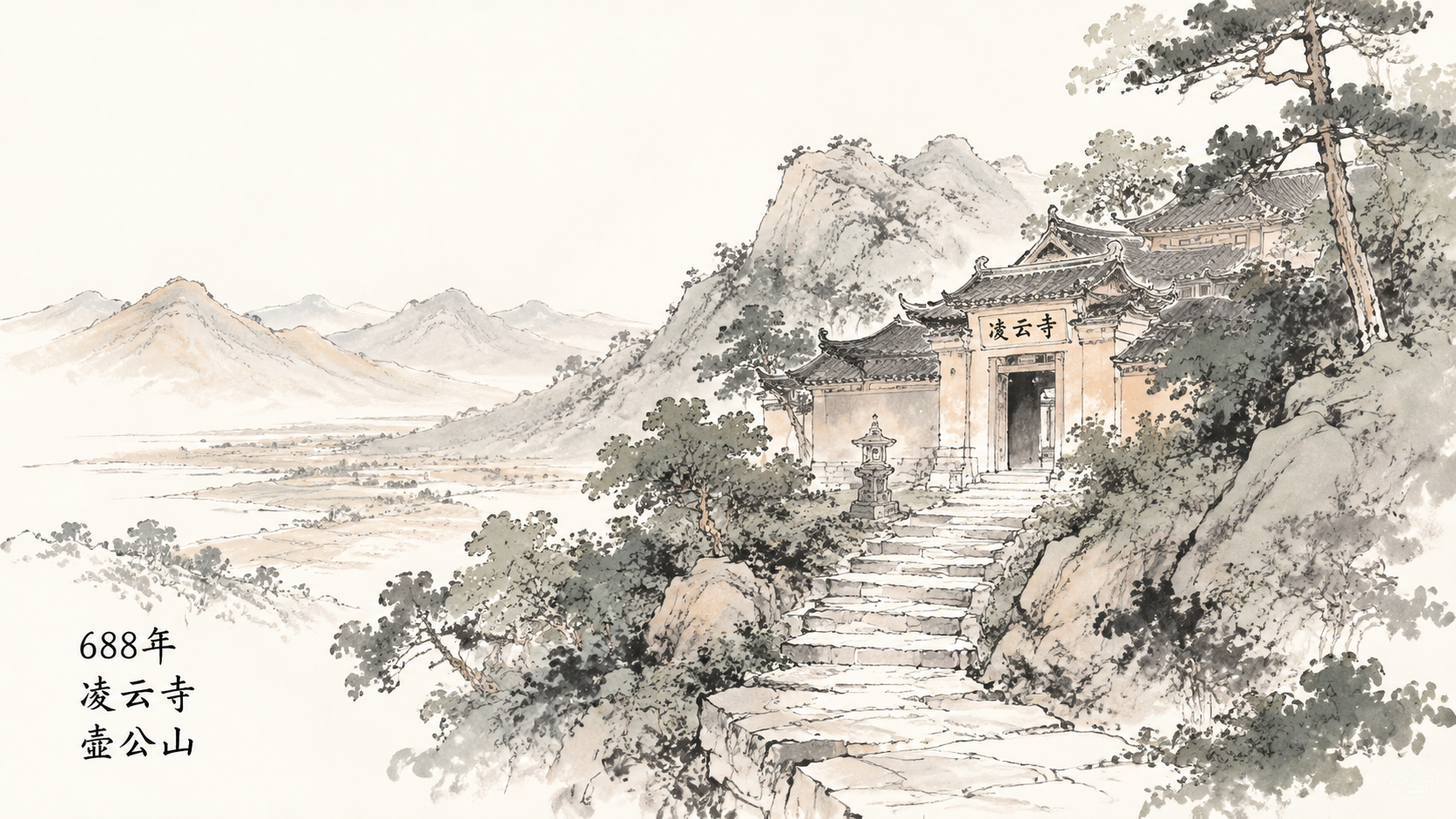
In 688 AD (the 4th year of Chuigong, Tang Dynasty), the Zen master Ruona founded Lingyun Temple on the mountain. That same year, Wu Zetian was preparing her coronation in Luoyang. Far away on the southeastern coast, a temple destined to burn incense for a thousand years was quietly taking shape.
By 1087 AD (the 2nd year of Yuanyou, Northern Song), Lingyun Temple had reached its zenith. It housed over a hundred monks and covered 2,500 square meters. Even Zhu Xi, the great Song philosopher, left his stone inscription here.
What strikes me most, though, is this: Mount Hugong preserves 18 ancient cliff carvings. During a 1980 cultural relics survey, archaeologists discovered 2 broken steles behind the temple, recording restorations during the Kangxi era.
Eighteen carvings. Two broken steles. They don’t speak, but they’re more convincing than any written record.
A Scholar’s Solitude
Mount Hugong is called the “Scholar’s Mountain” for good reason.
In 1523, a Putian native named Ke Weiqi earned his Jinshi degree. Disillusioned with officialdom, he returned to Mount Hugong around 1540 and built a study called “Xishi Shanshe” (Western Chamber Mountain House).
Then he did something remarkable.
He shut himself away for 20 years and wrote a 200-volume work: the Song Shi Xin Bian (New Compilation of Song History).
200 volumes. 20 years. One mountain. One man.
This isn’t a legend. It really happened on this mountain.
Ke Weiqi wasn’t alone in his efforts. The Ke family built three academies at the foot of Mount Hugong. During the Ming Dynasty, 45 Jinshi scholars emerged from the areas around this mountain.
Forty-five Jinshi. Any county in China would be proud of that number.
The Forgotten Forest
Mount Hugong has another side.
In 1957, the Putian County Forestry Bureau began large-scale afforestation here. The coverage fluctuated during the 1958 Great Leap Forward forest census. But after ecological restoration efforts began in 1962, the mountain now boasts 12,000 mu of forest with over 300 plant species.
From 1957 to today—nearly 70 years—a mountain transformed from barren to a thriving ecological regulator with 300 species.
What’s fascinating: in the 1990s, the local government restored a 5.5-kilometer stone-stepped path called the “Eighteen Battle Paths.” Originally a defensive position built by local volunteer armies against Yuan troops at the end of the Southern Song Dynasty (around 1276), it’s now a hiking trail for Putian citizens.
From battlefield to footpath. From defense to leisure. The mountain’s role changed, but the mountain remains.
Mount Hugong in Numbers
If I had to sum up Mount Hugong in one word, I’d choose “measure.”
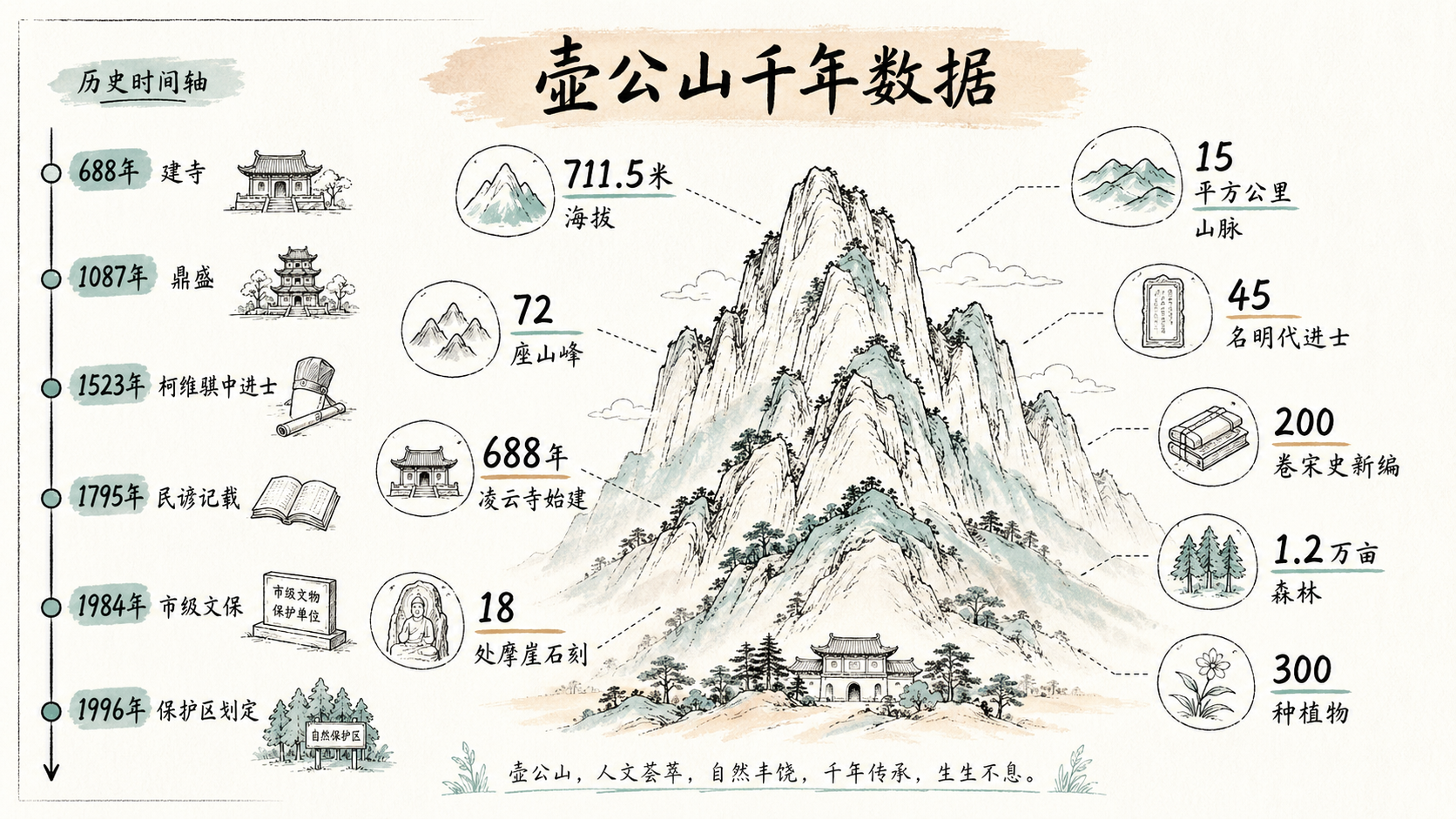
A measure of geography — 711.5m peak, 15 square kilometers, 72 peaks. A measure of time — temple founded in 688, peak in 1087, Ke Weiqi in 1523, proverb recorded in 1795, cultural protection in 1984, 2,200-hectare buffer zone in 1996. A measure of culture — 18 carvings, 3 academies, 45 Jinshi, 200 volumes. A measure of ecology — 12,000 mu of forest, 300 plant species, 500 mu of restored native forest. A measure of digital reach — 10 million short video views in 2023.
Behind every number lies a layer of Putian’s collective memory of this mountain.
The Mountain Still Stands
Few people today read Ke Weiqi’s Song Shi Xin Bian. Lingyun Temple no longer burns incense as it did in the Tang Dynasty. Some of the 18 carvings have been weathered beyond recognition.
But Mount Hugong still stands.
It still predicts the weather. It still grows trees. It still welcomes every hiker.
For a mountain, that’s probably the best possible ending.
Mountains don’t speak. But mountains remember everything.