Pingxiang, Anyuan, Songjiafang, Xiangdong, Xiashankou, Gaokeng, Wangjiayuan (Jiangxi); Liling, Zhuzhou (Hunan); Hankou (Hubei); Shanghai
In the summer of 1897, a German engineer arrived in Jiangxi and changed the history of a small county town forever.
In June of the 23rd year of Guangxu’s reign, Sheng Xuanhuai, the Imperial Minister for Railway Affairs, acting on the advice of Zheng Guanying, dispatched Zhang Zanchen and German mining engineer Gustav Leinung to Anyuan for a field survey. After his geological investigation, Leinung delivered a staggering figure—500 million tons of coal reserves lay beneath Anyuan.
That number sealed Sheng Xuanhuai’s resolve.
4 Million Marks: A Gamble on Steel
On March 1, 1898, the General Bureau of Pingxiang Coal Mines was officially established in Anyuan.
But there was one pressing question: where would the money come from?
Sheng Xuanhuai mortgaged properties of the China Merchants’ Steam Navigation Company in Shanghai’s Yangjingbang area to secure a loan of 4 million Marks (approximately 1.5 million silver taels) from the German firm Carlowitz & Co. in 1899.
This was no ordinary loan. The contract stipulated that 3 million Marks must be used to purchase modern machinery from Germany, with only 1 million Marks available in cash for civil engineering works.
From its very first day, the Pingxiang Coal Mine was tied to the tracks of German industrial technology.
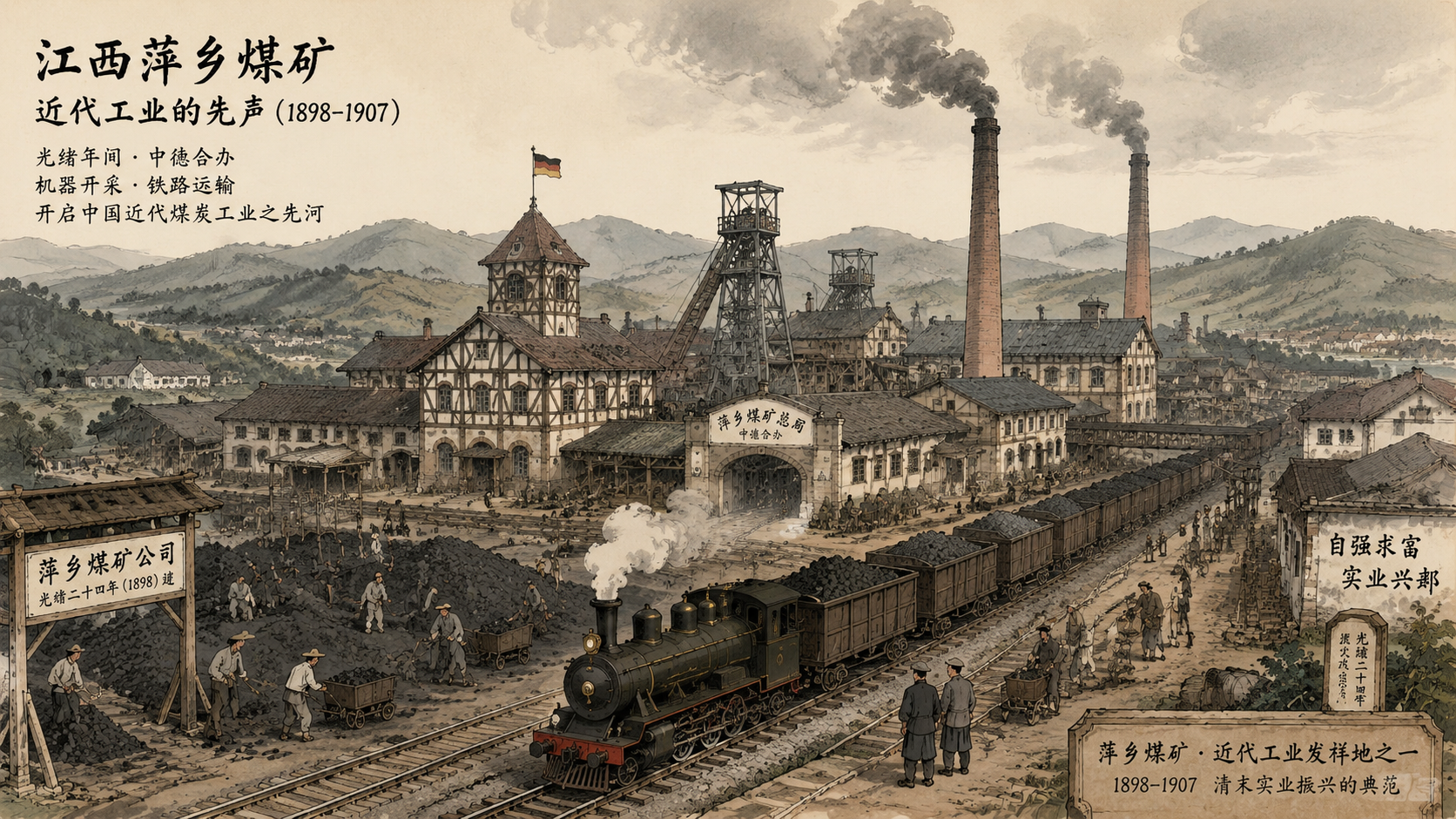
As it turned out, this was precisely what Pingxiang needed. The infusion of German capital introduced East Asia’s most advanced mechanized coal mining, washing, and coking technologies to the region.
Two Decades of Technical Stewardship
Gustav Leinung—this German name is inseparable from the history of the Pingxiang Coal Mine.
Hired under a high-salary contract for 20 years, Leinung served as the Chief Mining Engineer. He was responsible for everything from underground tunnel development to surface industrial architecture.
In 1905, Pingxiang became the first mine in China to use pneumatic drills for boring—replacing primitive manual hammering methods that had been used for millennia.
By the mine’s completion in 1907, it was equipped with three vertical shaft windlasses and 12 electric pumps, forming an integrated system of mechanized mining, transportation, washing, and coking.
The results spoke for themselves. In 1916, Pingxiang reached a production peak of 950,000 tons of coal and 260,000 tons of coke, with a workforce that surged to over 17,000.
Leinung also helped establish a rigorous management system based on “unified authority, specific responsibility, and strict auditing,” while training a generation of local talent such as Chen Shengfang.
Cradle of Jiangxi’s Industry
The modernization at Pingxiang went far beyond coal extraction.
In 1906, a thermal power station was completed, initially installing two 14.5 kW DC generators, later expanded with two 2,000 kVA AC turbine units.
This marked the beginning of industrial electricity use in Jiangxi Province—and one of the earliest self-provided power plants for a coal mine anywhere in China.
Simultaneously, to maintain and repair mining machinery, the bureau established a large machinery manufacturing plant in Anyuan. Equipped with 64 machine tools and six specialized workshops—pattern making, casting, forging, boiler repair, and others—it became Jiangxi’s first large-scale machinery plant.
How advanced was it? It could manufacture small coal cars and steel bridges.
Additionally, the mine built 254 mechanized coking ovens, utilizing waste heat to generate electricity—a pioneering feat in China at the time.
Extraction, washing, coking, power, machinery—this integrated industrial system cemented Pingxiang’s reputation as the “Coal Capital of South China.”
Industrial Will in Red Brick and Grey Tile
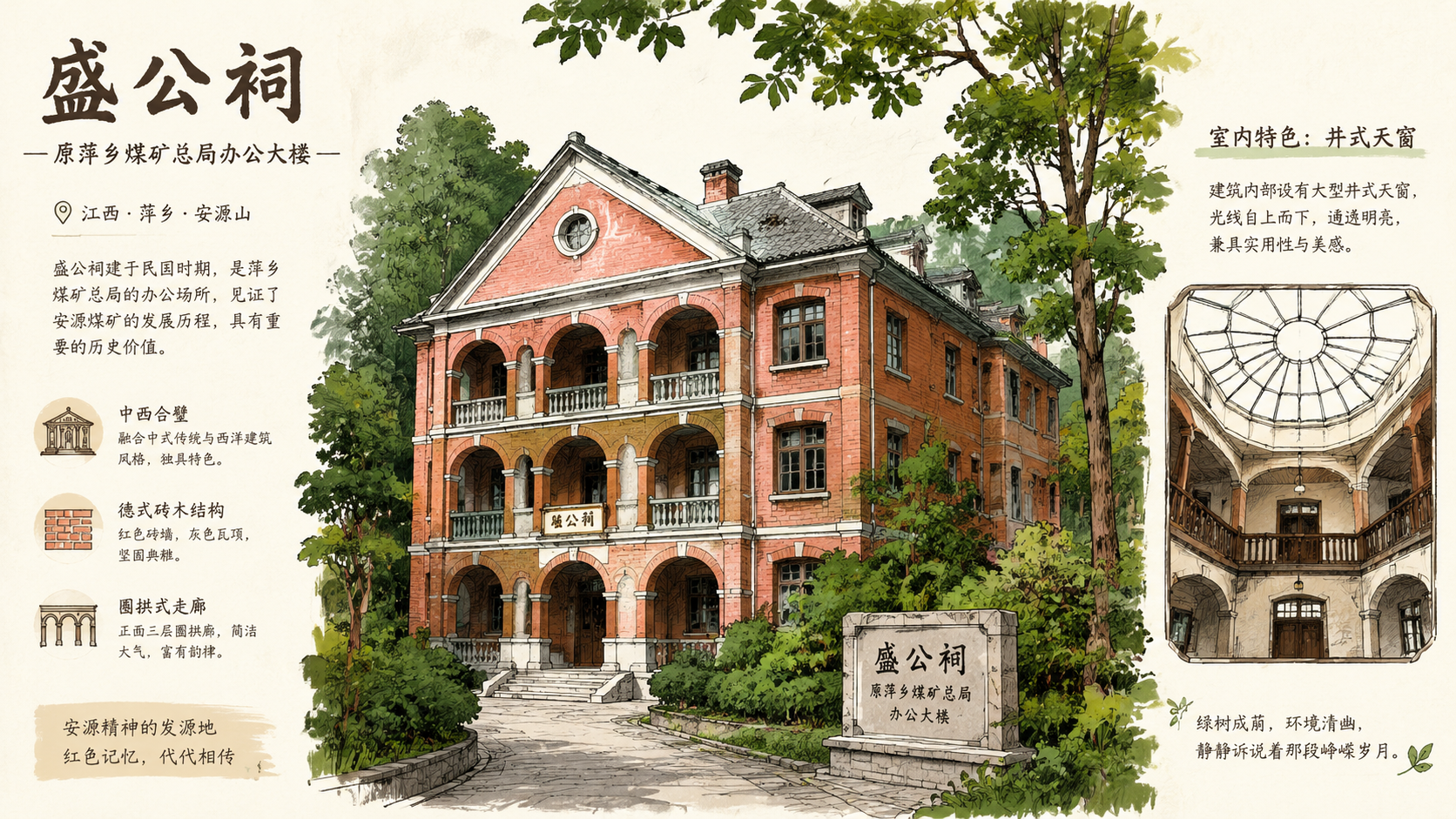
In 1906, the General Office Building of the Pingxiang Coal Mine was completed on a hillside in Anyuan.
Built in a Sino-Western hybrid German style, the structure covered 1,512 square meters and featured a three-story brick-and-wood frame surrounded by wide arched corridors.
Its most striking features included a Western-style triangular pediment on the facade, iron gourd-shaped railings, and three large skylights designed for interior lighting.
In 1921, to commemorate the mine’s founder Sheng Xuanhuai, the building was renamed “Sheng Gong Ci” (Sheng Memorial Hall), and a bronze statue of Sheng was erected inside.
Beyond being an administrative hub, Sheng Gong Ci served as the negotiation site during the 1922 Anyuan Strike—one of the most heroic chapters in modern Chinese labor history.
Today, this iconic industrial building remains a Major Historical and Cultural Site Protected at the Provincial Level in Jiangxi.
Jiangxi’s First Railway
Coal is worthless if you can’t ship it.
In December 1898, Sheng Xuanhuai commissioned Leinung for the railway survey, while Pingxiang Magistrate Gu Jiaxiang oversaw the acquisition of 333 mu (approximately 22 hectares) of land.
In June 1899—construction of the Ping-An Railway began.
This 7-kilometer (14-li) line, built to the standard 1.435-meter gauge, was Jiangxi Province’s very first railway.
But the most astonishing part wasn’t the railway itself—it was how they built it.
To transport the German locomotives to Pingxiang, workers devised a remarkable “temporary rail leapfrogging” method. Since the Pingshui River was too shallow for navigation and roads were nonexistent, they would lay 100 meters of track, haul the multi-ton locomotive forward, dismantle the track behind, lay it ahead—and repeat. Inch by inch, entirely by manual labor, they dragged the locomotive all the way to Anyuan.
On November 29, 1899, the Ping-An Railway officially opened for coal and coke transport.
The line was later extended to Liling in 1903 and Zhuzhou in 1905, eventually forming the 90-km Zhu-Ping Railway—one of the earliest self-financed railways in modern China.

References: Jiangxi Provincial Chronicles (Foreign Economic Trade, Construction Industry, Railways); Pingxiang City Chronicles.