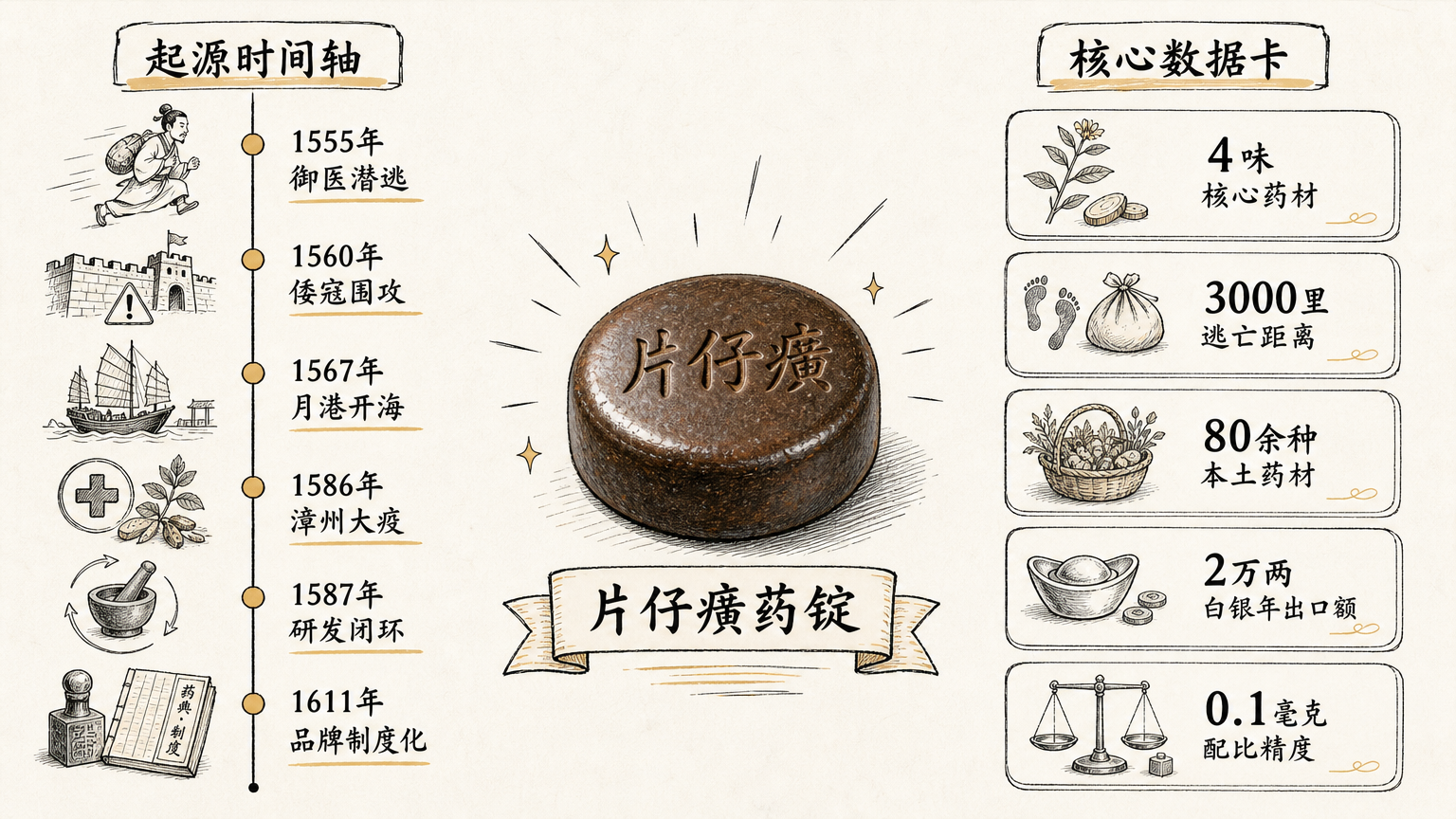
- A royal physician fled Beijing.
What did he take? A secret formula. Four ingredients: Musk. Cow Bezoar. Snake Gall. Tianqi.
In the Ming Dynasty, these four substances were crown monopolies. Civilians caught with them faced execution.
He ran 3,000 li. From the Forbidden City to Pushan Rock Temple, 10 li outside Zhangzhou.
When I cross-referenced the ‘Wanli Zhangzhou Chronicle’ and ‘Zhangzhou Medical Chronicle’ in a single database, line by line, I found something: this mountain didn’t just hide a fugitive’s refuge—it was ground zero for the globalization of Southern Fujian medicine.
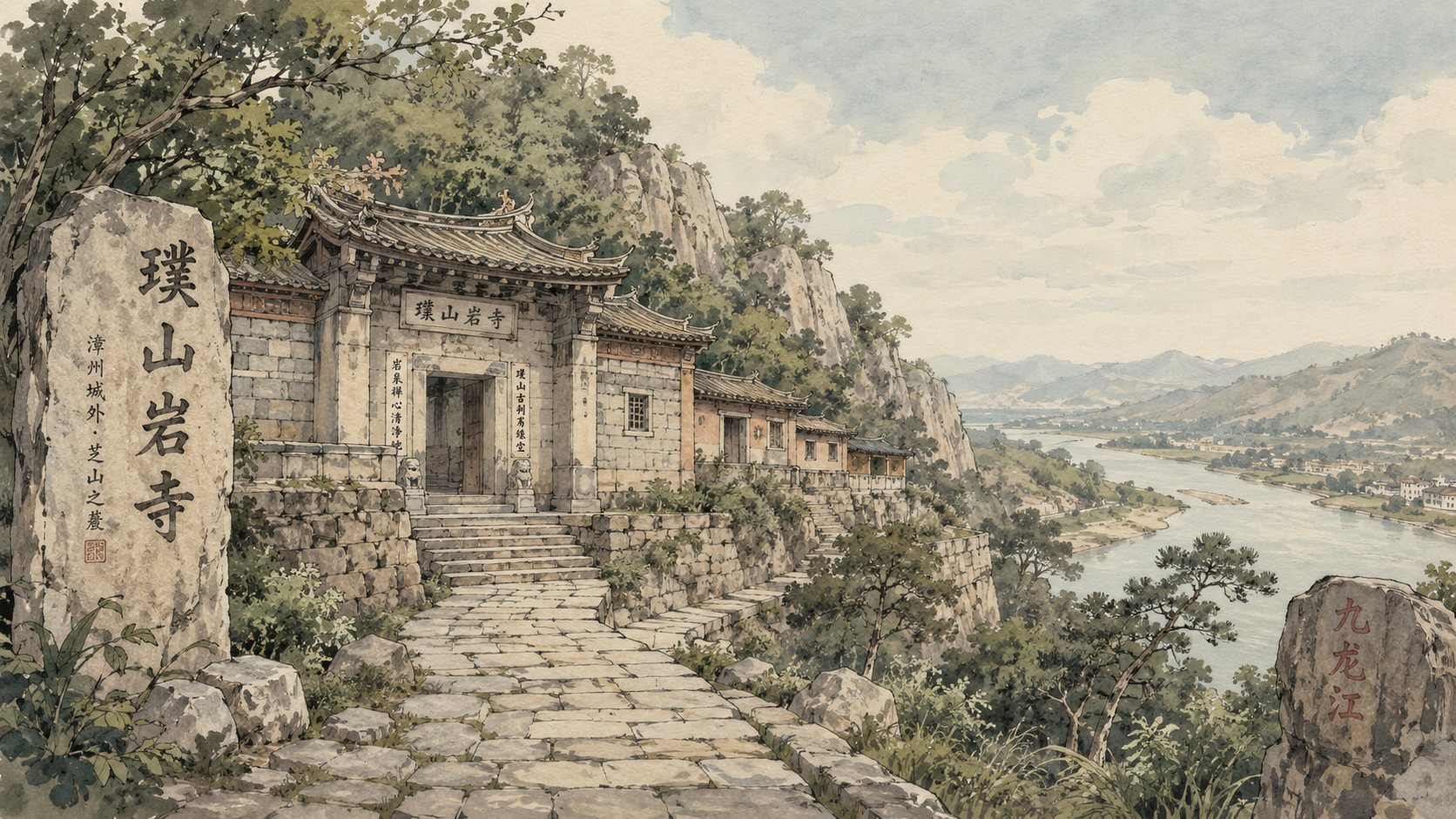
Geographic Links
Pushan Rock Temple (10 li outside Zhangzhou, where the physician took monastic vows) Mount Zhi (the natural barrier protecting Pushan Rock during Wokou raids) Jiulong River Branch (the waterway for herb transportation) Moon Harbor (the departure point for Pien Tze Huang’s overseas journey after 1567) Manila / Batavia (the overseas markets) Taiwan Prefecture (the endpoint of Zhangzhou formula migration after 1683)
I. Exile in the Gaps of Imperial Power
- Beijing was in chaos under Yan Song.
This physician’s surname was Yan. His given name? Not in the records—either deleted or deliberately erased. Only someone who could navigate Jiajing-era court politics and walk away intact would leave so few traces.
The formula he carried was no ordinary prescription.
Palace secret. Four characters: Musk, Cow Bezoar, Snake Gall, Tianqi. Musk came from the Tibetan Plateau. Cow Bezoar required gallstone surgery. Snake Gall meant catching live venomous snakes. Tianqi needed three years to cultivate in Yunnan forests. In the Ming, all four were crown monopolies. Possession by civilians was a capital offense.
I don’t know how he obtained them. But I know where he went after.
Pushan Rock Temple. 10 li outside Zhangzhou.
Why there? I checked the ‘Wanli Zhangzhou Chronicle · City Walls’: the prefectural wall stretched 2,150 zhang, and Pushan Rock sat precisely at the garrison system’s edge—the zone nobody managed.
- The great Wokou siege. Pushan Rock survived. Why? Backed by Mount Zhi’s foothills, facing a Jiulong River tributary—the terrain was too complex to assault profitably.
Over a decade. That’s how long the physician had to experiment undisturbed at Pushan Rock.
II. Localizing with 80 Herbs
The physician faced a practical problem: Zhangzhou might not have what the formula required.
I pulled data from the ‘Wanli Zhangzhou Chronicle · Local Products’: in the early Wanli period, Zhangzhou could harvest over 80 species of medicinal herbs.
Over 80 species. What does that mean?
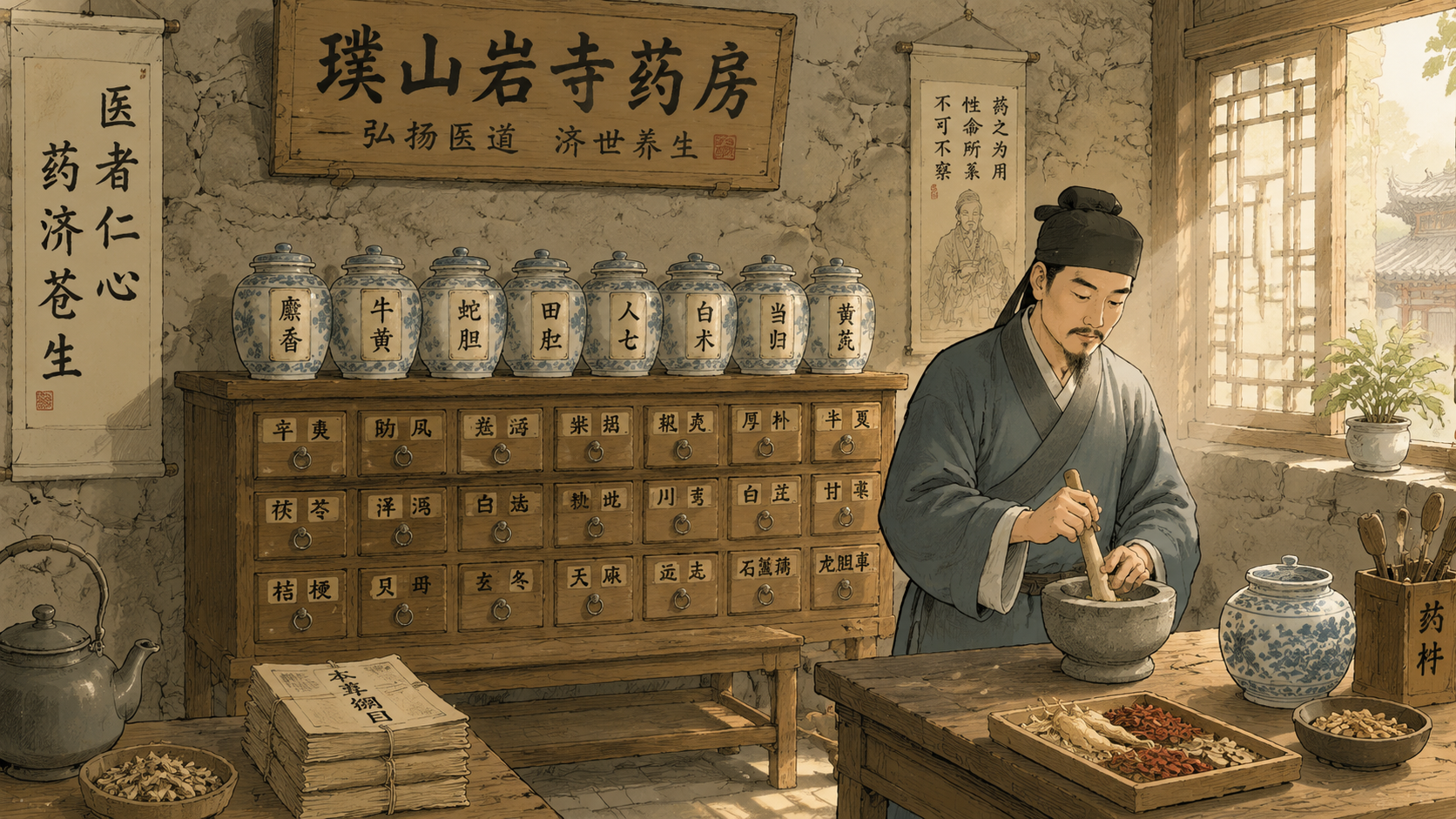
It meant the palace formula could be localized. No musk? Find substitutes. Scarce cow bezoar? Local snake gall had similar properties. He permutations-tested those 80+ herbs until Pien Tze Huang’s core formula stabilized.
Temple lands at Pushan Rock supported this process. The ‘Wanli Chronicle · Taxation’ shows temple land endowments accounted for approximately 8.5% of newly reclaimed fields. That money bought premium musk from the Western Regions—imported, because nothing local could replace it.
By 1587, this “temple-funded R&D” financial loop was fully operational.
III. 1567: One Maritime Ban Lifted Opens Global Markets
Pien Tze Huang’s journey from Pushan Rock to the world began with an imperial decree.
1567, the first year of Longqing. The Ming court lifted the Moon Harbor maritime ban. Zhangzhou’s Moon Harbor became China’s sole legal foreign trade port.
I checked the ‘Zhangzhou Foreign Trade Chronicle’: during the late Ming, medicinal exports through Moon Harbor averaged 20,000 liang of silver annually.
20,000 liang. What does that equal? A Grade 7 county magistrate’s annual salary was 45 liang. 20,000 liang = 443 magistrates’ total annual salaries, untouched.
The 1597 trade manifest didn’t list “Pien Tze Huang” directly. But it listed “Golden Potato Medicine Cakes” and “Temple-made Pills”—descriptions matching Pien Tze Huang’s documented effects.
They departed Moon Harbor for Manila, for Batavia, for all of Southeast Asia.
IV. 1586 Plague: One Prescription Becomes a Brand
Disaster is the best credential for a famous medicine.
1586, the 14th year of Wanli. A massive plague struck Zhangzhou. The chronicle’s original four characters: “Dead piled upon dead.”
The entire Lijia administrative system teetered on collapse. That’s when Pushan Rock’s Pien Tze Huang entered the story.
Local gentry established 4 charity clinics in the prefectural city. Free Pien Tze Huang distribution. The recorded effect was direct: countless lives saved.
After this plague, Pien Tze Huang’s status in Zhangzhou folk medicine was permanently established. Not through advertising—through hard survival data.
1611, the 39th year of Wanli, brand reputation was formally institutionalized.
V. Precision at 0.1 Millimeters
Today, Pien Tze Huang is a nationally classified secret formula.
Data I found shows: the ratio of natural musk, natural cow bezoar, snake gall, and tianqi requires precision at the 0.1-milligram level.
0.1 milligrams. One-tenth the thickness of a human hair.
The physician who fled Beijing in 1555 didn’t just smuggle out a piece of paper. He smuggled out a survival algorithm: preserving technology under extreme political pressure, localizing it in peripheral geographic space, finding commercial exit points in the tide of globalization.
That algorithm is still running, 400 years later.