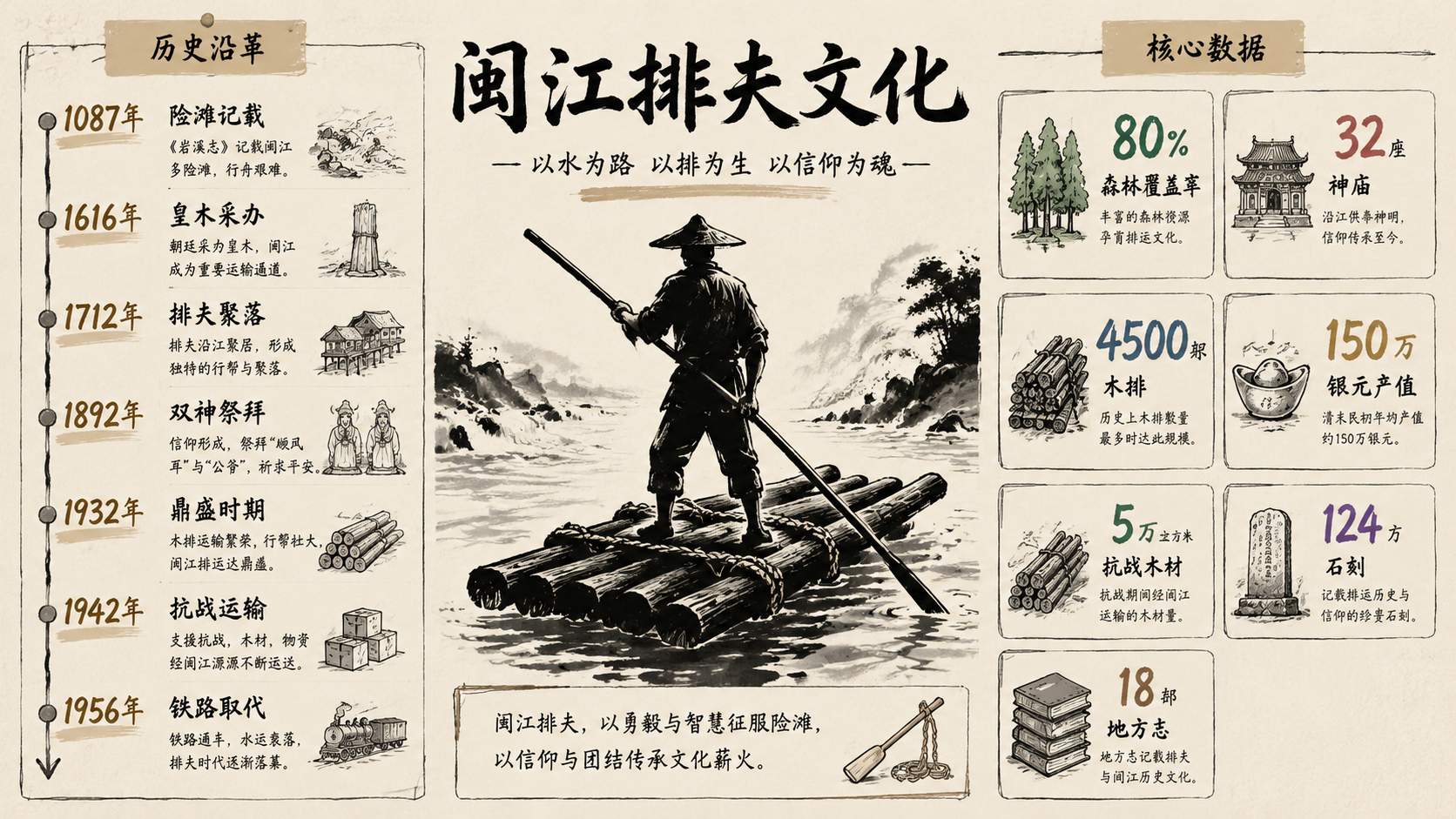
On the Min River, timber rafts floated like endless green dragons.
In 1934, the Futun Stream alone had 32 navigation temples. They guarded the life-and-death voyages of over 4,500 rafts each year.
This is the story of men and a river.
When I cross-referenced the Shaowu Prefecture Annals and Shunchang County Annals, I discovered a truth: every drop of rooster blood spilled into the river was a contract written with lives.
Geographic Connections
Guangze County (Hangchuan Wharf, Zhima Town) Shaowu City (Futun Stream, Shaikou, Zhaowu) Shunchang County (Yangkou Town, Shuangxi) Jianou City (Jian Stream, Zhichuan) Fuzhou City (Taijiang Wharf, Bangzhou) Nanping City (Yanping)
I. Rapids Like Tigers
In 1087 (Yuanyou 2), records from Jianzhou described the upstream Min: “Jagged rocks fill the air; a slight error by the oarsman means total destruction.”
With forest coverage exceeding 80%, timber was truly “green gold.” Yet transport depended entirely on human strength.
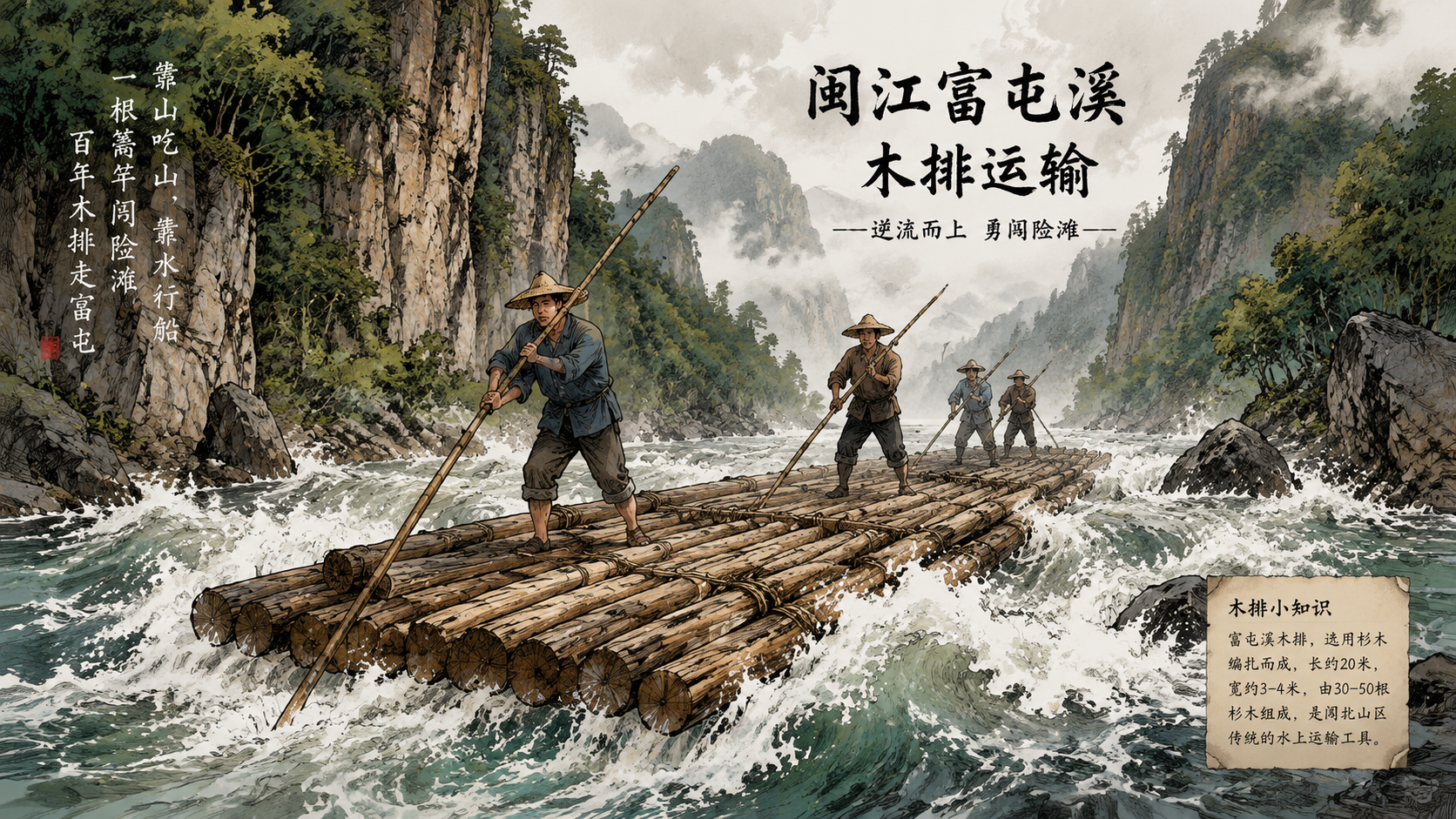
In 1830 (Daoguang 10), the Shunchang County Annals documented the “Large Raft”: 30 to 50 cedar logs bound together. When these massive structures navigated narrow stone passages, rafter mortality was alarmingly high.
In 1932, timber output in Shaowu alone reached 1.5 million silver dollars. This wealth flowed on the long poles of tens of thousands of rafters.
II. General Yang Si’s 32 Temples
Unlike the coastal Mazu cult, Min River rafters revered General Yang Si.
In 1616 (Wanli 44), when the court procured “Imperial Timber,” grand sacrifices were held at Shaowu’s Zhaowu Temple. Rafters believed Yang Si controlled the river’s flow.
A 1934 survey revealed 32 temples dedicated to him along the 150km stretch from Guangze to Shunchang.
They worshiped both Yang Si and Mazu. An 1892 inscription by Nanpu Stream recorded that rafters must honor both “Lord Yang” and the “Heavenly Empress” before departure.
III. The Blood Sacrifice Ritual
Before launching, every raft underwent a “consecration” ceremony.
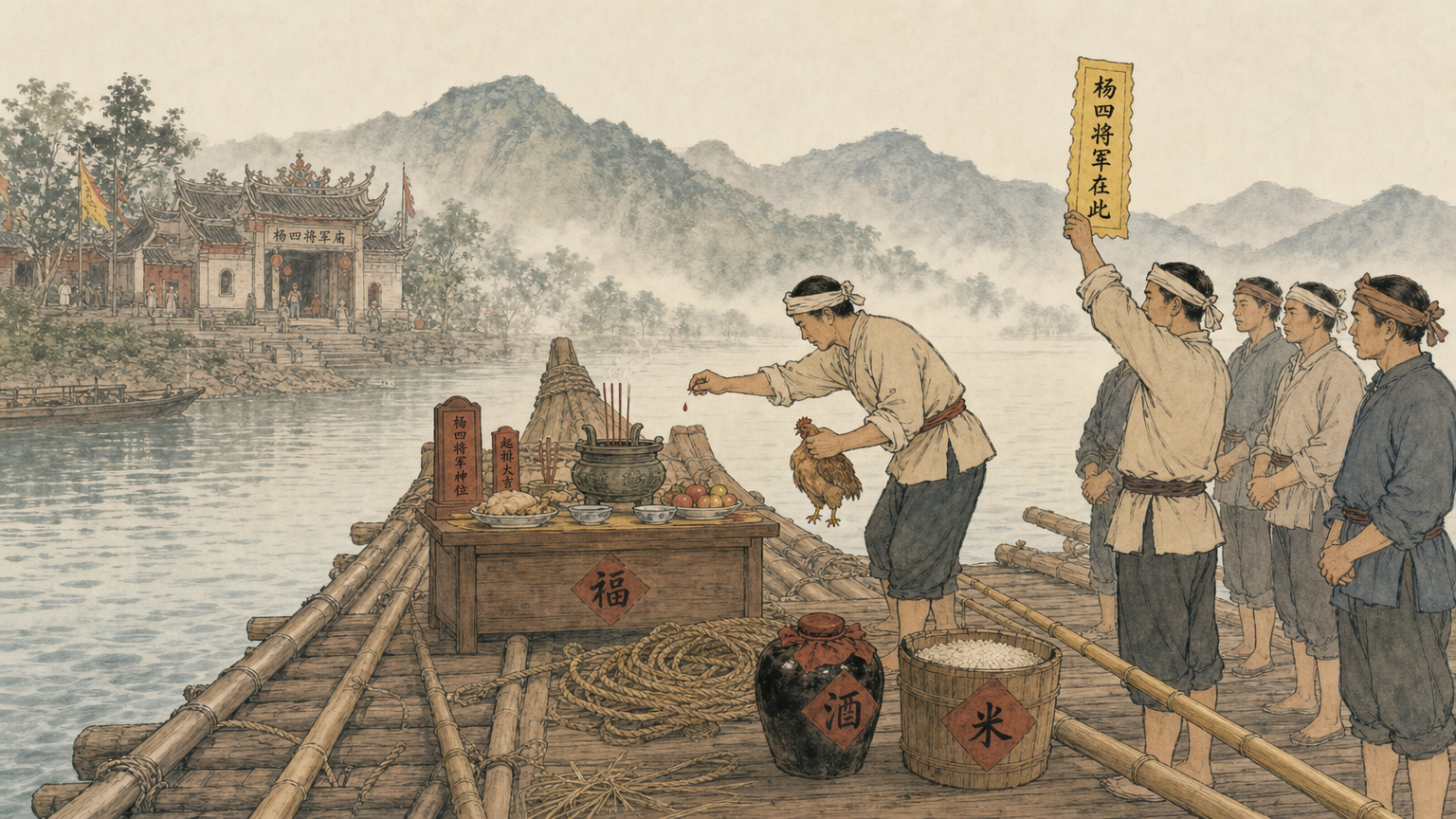
An 1815 contract specified that merchants paid a special “incense fee.” The core ritual involved sacrificing a rooster and dripping its blood on the raft’s bow, accompanied by yellow charms inscribed with “General Yang Si is here.”
Rafters tied red silk to their poles—their only visual marker in the white rapids.
When passing dangerous shoals, they tossed wine and rice into the river as “offerings to the water officials.” In 1942, to support the war effort, Shunchang mobilized 50,000 cubic meters of timber, preceded by a massive blood sacrifice.
Language taboos were strict: words like “sink,” “capsize,” or “stop” were forbidden. If a raft broke, rafters knelt before the nearest temple until forgiven.
IV. Guilds and Divine Governance
Rituals were not just folk practices—they were commercial regulations.
In 1932, Shaowu timber guilds allocated 0.5% of profits annually for temple repairs and festivals. This economic bond sustained the faith.
Across Northern Fujian, 124 stone inscriptions record these trade rules.
An 1892 stele decreed: gambling or drinking during rituals would result in severe punishment by “divine consensus,” even expulsion from the wharf.
The fusion of divine and human governance maintained order in these treacherous waters.
V. The Vanishing Rafters
In 1956, the Yingtan-Xiamen Railway reached Shaowu. Trains replaced rafts.
After 1958, hydropower dams blocked the waterways. The era of “ten thousand rafts” ended.
Most of the 32 temples were abandoned or repurposed.
Yet by digitizing 18 local chronicles, we can reconstruct the rafters’ cultural landscape. GIS maps of temple locations reveal the psychological terrain of laborers battling nature.
This digital memory endures longer than physical temples.
VI. Numbers Tell the Story
I compiled these figures:
- 80%: Forest coverage in Northern Fujian
- 32: Navigation temples along Futun Stream (1934)
- 4,500: Annual rafts
- 1.5 million silver dollars: Shaowu timber output (1932)
- 3,000: Rafter community in Jianou (1712)
- 50,000 m³: Timber mobilized for war effort (1942)
- 0.5%: Guild contribution to ritual expenses
- 124: Surviving stone inscriptions
- 18: Digitized local chronicles
Behind each number lies an epic of survival written on the rapids.