Fuzhou, Mawei, Tianjin, Beijing, London, Greenwich, Portsmouth, Xiamen, Shanghai
Do you know who translated “survival of the fittest” into Chinese?
It was a man from Fuzhou named Yan Fu.
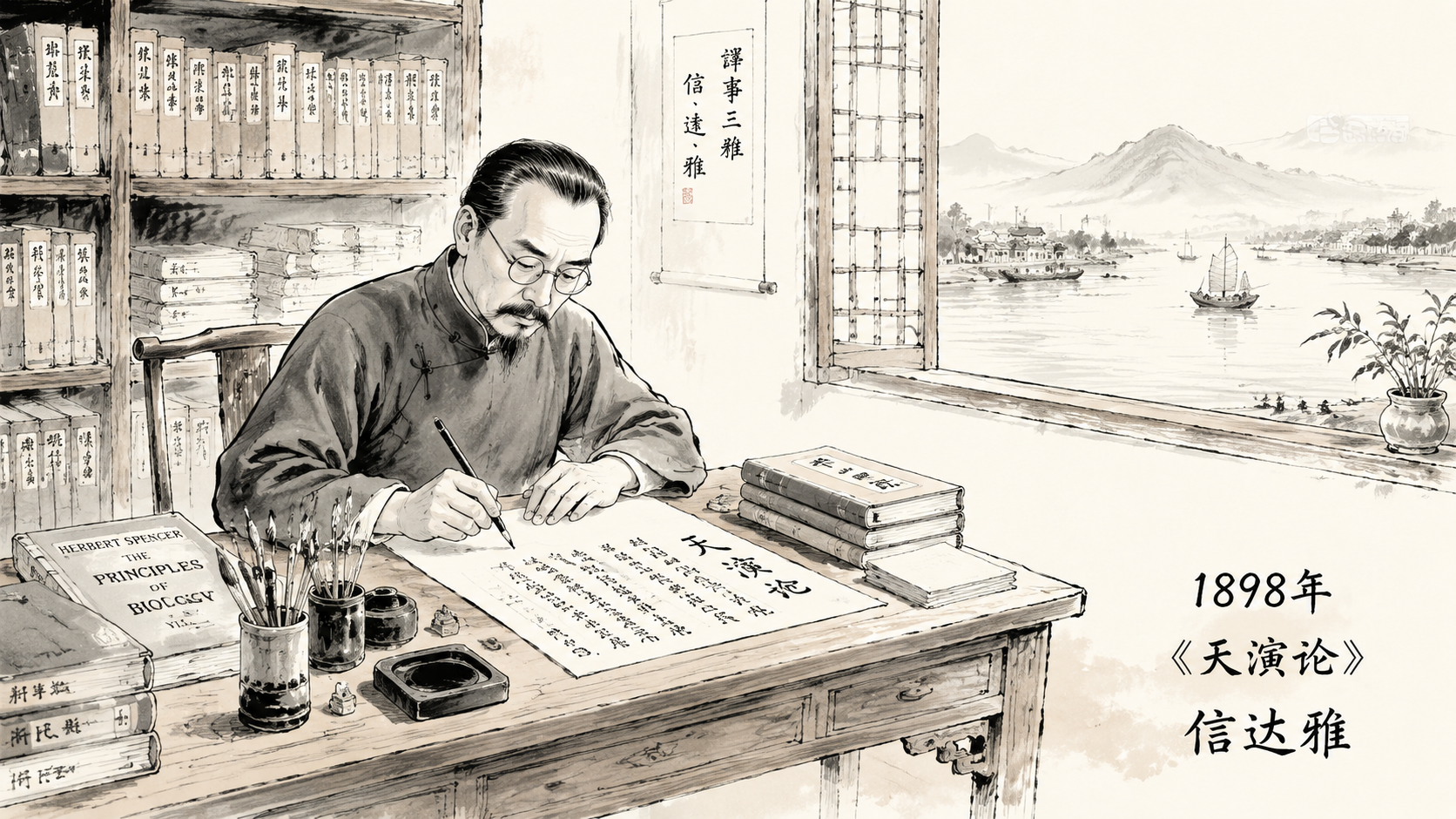
In 1898, a book called Evolution and Ethics was quietly published. Its core message—“natural selection, survival of the fittest”—exploded across late Qing China like a bombshell.
Lu Xun later recalled that while studying in Nanjing, he would sit on the ground reading Evolution and Ethics on Sundays. After finishing it, his entire worldview had changed.
The man who wrote that book was Yan Fu. From Fuzhou.
His life reads like a novel.
From Humble Roots to Arsenal Top Graduate
Yan Fu was born in 1854 into a family of traditional Chinese medicine practitioners in Fuzhou’s Cangshan district.
In 1866, his father died, plunging the family into poverty. That same year, the Fujian Shipyard was founded in Mawei, offering full scholarships to students.
Yan Fu took the exam. He ranked first.
He entered the Rear School of the Arsenal, studying mathematics, physics, chemistry, astronomy, navigation, and English.
This was a modern education unprecedented in Chinese history. He also boarded warships like the Jianwei and Yangwu, sailing to Singapore, Nagasaki, and Yokohama.
A poor boy from Fuzhou had seen the world for the first time.
1877: A Fuzhou Man in London
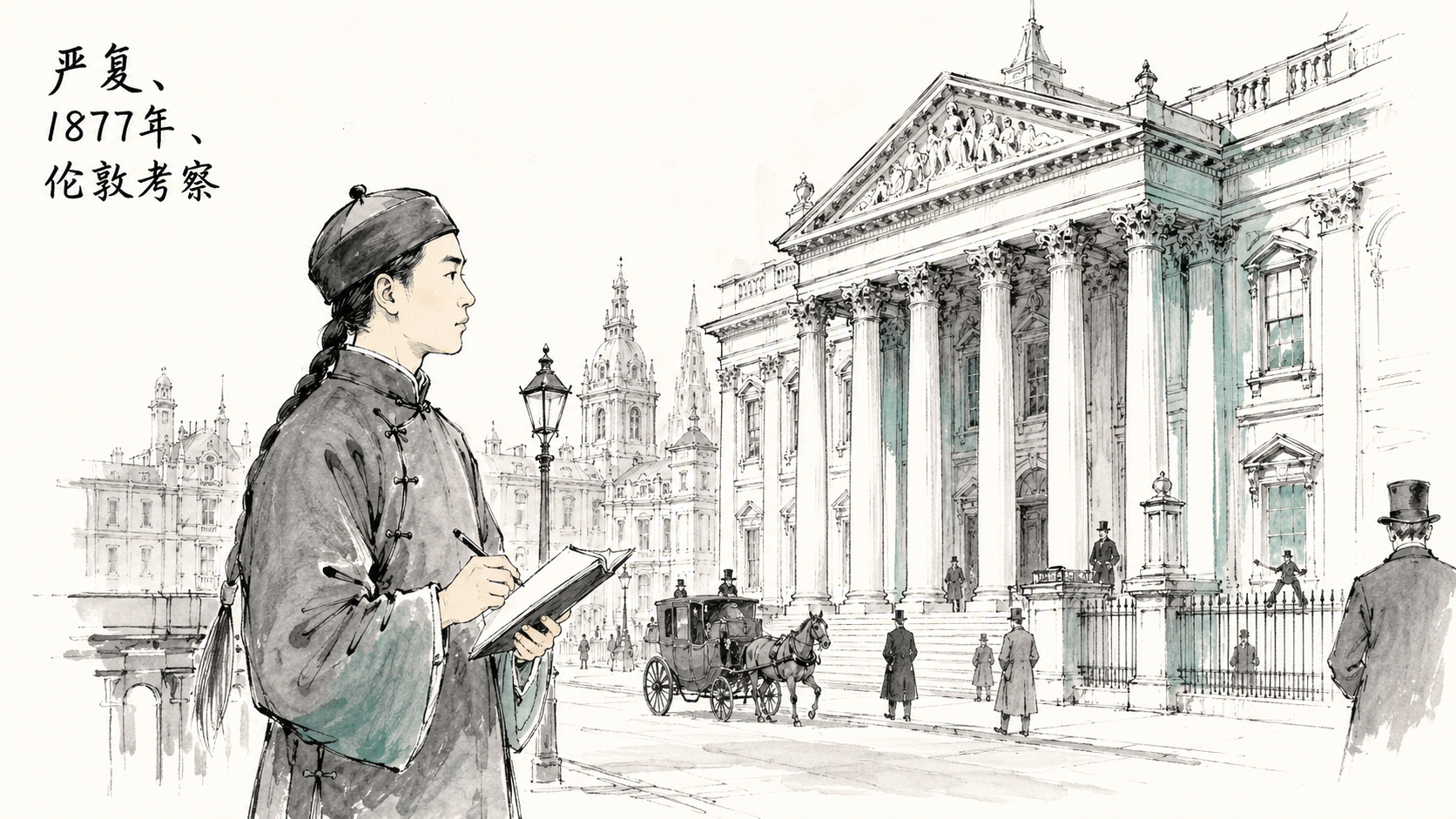
In 1877, Yan Fu was selected as one of the first government-sponsored students to study in England.
At Portsmouth College and the Royal Naval College, Greenwich, he studied naval science. But his gaze extended far beyond warships and cannons.
He did something no other overseas student did at the time—he observed British court trials firsthand.
He sat through an entire court proceeding and witnessed judicial independence with his own eyes. In that moment, he realized: China’s problem wasn’t weak ships or insufficient firepower. It was the system.
In 1879, Yan Fu returned to China. He was no longer the same technician who had left three years earlier.
One question consumed his mind: What should China do?
1898: The Sound That Awakened the East
In 1894, the Sino-Japanese War ended in catastrophic defeat. The Beiyang Fleet was annihilated.
Yan Fu was then the Superintendent of the Tianjin Naval Academy. In grief and fury, he wrote to his son, saying China’s calamity stemmed from “the falseness of current scholarship” and “the corruption of the literati’s hearts.”
He decided to awaken China with his pen.
In 1895, he published a series of influential essays. In 1898, Evolution and Ethics was published.
“Natural selection, survival of the fittest”—eight Chinese characters that became the rallying cry of an era. Countless patriotic youth found their theoretical foundation in these words.
Over the following decade, adhering to his principles of “Faithfulness, Expressiveness, and Elegance,” Yan Fu translated eight major Western classics, including Adam Smith’s The Wealth of Nations, Montesquieu’s The Spirit of the Laws, and Spencer’s The Study of Sociology.
Total volume: over 1 million Chinese characters.
One Fuzhou man, with one pen, translated the most advanced Western thought for China.
First President of Peking University
In 1912, the first year of the Republic, Yan Fu was appointed by Yuan Shikai as the first President of Peking University.
From an Arsenal School student to the head of China’s highest institution of learning.
His life was a microcosm of modern China’s transformation.
But Yan Fu’s later years were lonely. He grew skeptical of “democracy and republic,” and his involvement with the “Chou’anhui” brought controversy.
On October 27, 1921, Yan Fu passed away in his hometown of Fuzhou at age 68.
His final will advised: “Follow reality, and avoid empty words.”
A Fuzhou Man’s Legacy
Yan Fu is gone. But what he left behind outlives him.
Eight major translations, over 1 million words. The translation principle of “Faithfulness, Expressiveness, and Elegance” is still used today.
Most importantly—he introduced China to the theory of evolution, an intellectual system that fundamentally changed humanity’s understanding of the world.
From the decks of Mawei Arsenal, to the Royal Naval College in Greenwich, to the podium of Peking University.
Yan Fu proved one thing: thought is the most powerful weapon of all.
Yan Fu in Numbers
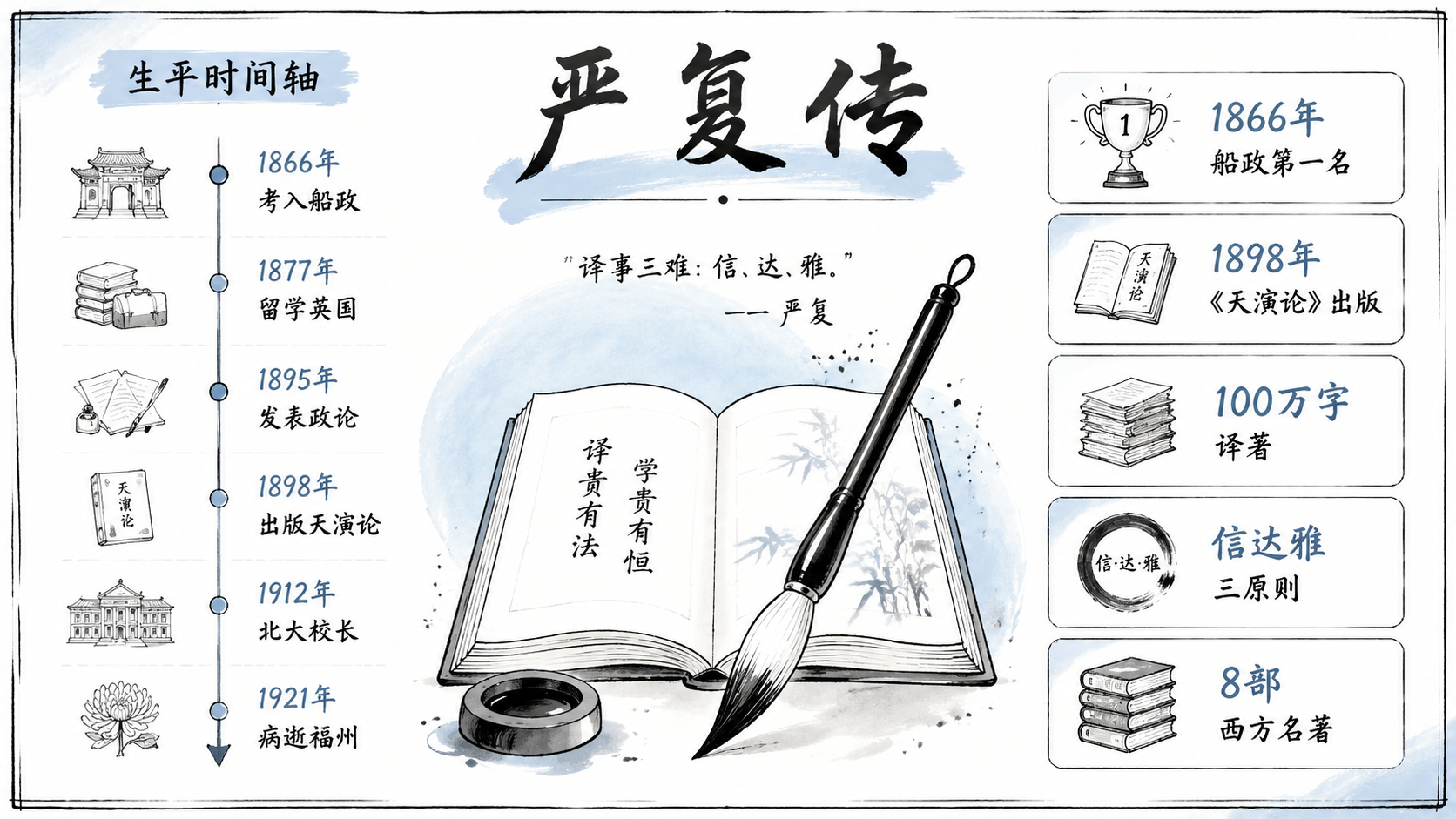
- 1866: Entered Mawei Arsenal School, ranked first
- 1877-1879: Studied in England, observed Western governance
- 1895: Published political essays, began enlightenment
- 1898: Evolution and Ethics published
- 1912: First President of Peking University
- 1921: Passed away in Fuzhou, age 68
- Translated over 1 million words of Western classics
- “Faithfulness, Expressiveness, Elegance” translation principle
An Arsenal student. A pen. Ten thousand books.
That was Yan Fu.
Yan Fu didn’t bring back warships or cannons to China. He brought back something far more precious — ideas.